"Hacking Your Genes" at SF Nerd Nite
The Omega-3 Supplementation Guide
A blueprint for choosing the right fish oil supplement — filled with specific recommendations, guidelines for interpreting testing data, and dosage protocols.
You'll also receive updates from Rhonda & FoundMyFitness
Dr. Rhonda Patrick talks at SF Nerd Nite about transgenerational effects of caloric restriction on longevity, B-vitamins silencing bad genes, cognitive stimulation reversing neurodegenerative disease, exercise increases neurogenesis, and ways in which vitamin D might influence aging.
While we get the slides up, my name is Rhonda Patrick. I have a PhD in biomedical science. I've done research ranging from aging and cancer to nutrition and metabolism. And in the next 20 minutes or so, we're going to explore this question: are your genes your destiny? And we're going to starve some monkeys, we're going to starve some kids, we're going to lick some rat brains, and hopefully by the end we'll come to the conclusion Which, if I had to guess, it's going to be yes and no. So— Last September, I moved to the Bay Area and I took a postdoc with this guy here, Dr. Bruce Ames. You may be familiar with Ames test. So, I'm— my research here tries to understand— there's a robot staring at me— tries to— I'm trying to understand the links between obesity and cancer.
Now, most people are aware that obesity increases the risk of disease like diabetes and cardiac or cardiovascular disease. But, you know, why obesity increases the risk of cancer isn't well understood. So I'm hoping that my research can shed some light on that. So this is the typical American family diet. Oh. Or as I like to call the obesogenic diet. So if you look closely, most of the food on this table is processed foods. It's packaged in boxes, jars, cans. Very little to no fruits and vegetables, which is a really bad thing because fruits and vegetables are the primary source of essential vitamins and minerals called micronutrients. And these micronutrients are really important for this, which is terrifying.
It's a snapshot of some of the biochemical pathways that are occurring in your body every day, and these essential vitamins and minerals are important to have these things function. So you can imagine that in the absence of these essential vitamins and minerals, minerals, things can go wrong. My ears are very tiny. Okay. So obesity is now reaching epidemic levels in the United States. In fact, about 60 million people suffer from this disease in America. And childhood obesity is growing by 50% per decade. So that leads me to ask the question, are we de-evolving? Oh. So we've gone from a caveman diet to a McDonald's diet. To a pig. Yes, it is a gun. And so fear not, I'm not a paleo fanatic.
I'm not here to convince you that you should adopt a caveman diet, although nuts and berries are good for you. I am a scientist and I am going to show you some data that I find interesting because it suggests that what we eat and what we do in our lifestyle may in fact change the expression of our genes. And I'm going to explain that in just a second. But first, I want to introduce you to the concept that was introduced in the early 1800s by a fellow named Jean-Baptiste de Lamarck. And can everyone hear me? Is this mic like very— Yes. Okay. All right. Because my ears are really tiny and this thing is like falling off. Okay. So Jean-Baptiste de Lamarck. He was really one of the first grand theorists in biology. In fact, he coined the word biology.
And Lamarck thought that our environment could change our genes and that this could be passed on to our offspring. And so his classic example was the giraffe. Lamarck said, well, you want to know how a giraffe got its long neck? It spent a lifetime reaching real high up to reach the leaves on top of trees, and then it had a baby giraffe and it passed on the stretched, stretched neck to the baby giraffe. And he thought that this is how it worked for humans as well. But we know from Darwinian evolution that no amount of mommy stretching is going to give you longer limbs. Mm-hmm. But he wasn't entirely wrong. So I'm going to introduce you to the epigenome. This is a very simplistic version of it.
So epigenetics refers to changes in gene expression without actually altering the DNA nucleotide sequence. And these epigenetic factors, they'll sit on top of your DNA and they'll turn genes on and they'll turn genes off. And when they turn genes on, a gene is active. It's being expressed. It's doing what it's supposed to do. When a gene is turned off, It's being silenced. It's not being expressed. It's almost as if it's not there. And the really cool thing about this, and this is where Lamarck comes in, is that these epigenetic marks are regulated by our environment, by what time of day it is, by what we eat, by how much we eat, by how much exercise or stress we're under. And so to highlight epigenetics in play, I'm going to show you a piece of data here. These monkeys are the same age.
The monkey on the left has had a normal diet throughout its life. The monkey on the right has had 30% less food for its 27.6 years of its life. That's called caloric restriction. Not only does the monkey look younger, but actually biologically is younger. So this monkey here is less likely to get diabetes, cancer, and neurodegenerative disease. People, take a look at this monkey on the right. Look how much younger it is and think about which monkey you want to be. We know that these monkeys had changes in their gene expression. We can actually measure the expression of thousands of genes at once. By gene expression profiling. Genes that are being expressed, the ones that are active, those are indicated in red.
And the genes that are being turned down, the ones that are silenced, are indicated in green. And these monkeys had changes in gene expression as they age. So the monkey that was eating a normal diet, as much food as it wanted when it wanted, it was increasing the expression of bad genes, genes involved in inflammation and stress. And it was decreasing the expressions of good genes like neurotrophic factors, which are important for the growth of new brain cells. And the monkey, the caloric-restricted monkey, had the opposite genetic expression profile. So it was decreasing the bad genes. It was decreasing expression of genes involved in inflammation and stress, and it was increasing the good genes. That's unbelievable.
So the really cool thing about epigenetics, and this is where Lamarck comes in again, is that these epigenetic marks that are regulated by our environment They sort of hitchhike on the egg and sperm DNA and they can be passed on to your children and grandchildren. So to highlight the importance of this, I'm going to tell you a story about Norrbotten, Sweden. And Norrbotten is the northernmost tip of Sweden. It's very isolated, or at least it was very isolated. very isolated during the early 1800s. And so people that lived there during this time were very dependent on the crop harvest for their food. So if the crop harvest was poor, so if it was a long winter, you know, people were on the brink of starvation. They barely had enough food to survive.
And in contrast, if the crop harvest was very good, there was an abundance of food. So what do people do? Well, they starve— I mean, they gorge themselves. And so the cool thing about Nervaton is they They have extensive historical and agricultural records that date everything from when a person was born to how good-looking they were to how smart they were to what they died of. And this provided an interesting opportunity for a couple of Swedish scientists to ask a question. And that question is, were there any effects that growing up during these famine versus feast years had on future generations? And what the Dutch study found was that if you were a male, between the ages of 9 and 12 growing up during the famine years, then your kids and your grandkids were gonna be healthier.
Your grandkids, in fact, were gonna be 1/4 less likely to get diabetes and cardiovascular disease, and they were gonna be on— live on average 32 years longer than the grandkids of the happy, well-fed granddads. Hmm. So the data's there, but the The mechanism as to why that is is not so clear. So if you think— we can only speculate. And if you think about what's going on in a male between the ages of 9 and 12, this is the prepubescent stage. It's sort of when they start to form these pre-sperm cells. And so it's— we could think that possibly something about starving during that period of time makes a happy sperm. And that happy sperm gets passed on to the grandkids.
So the bottom line here is, I guess not many of you have kids, but if you— when you have kids, when your son's about 9 years old, just cut him off. Just say, honey, I'm sorry, I know this is going to hurt, but I'm going to starve you for a couple years because it's going to make your sperm happy. Okay, so let's look at more of a controlled environment here. So this is the opposite end of the spectrum. This study was done in Australia, and researchers took male mice They fed them a diet that was really high in fat. Those male mice got fat and got diabetes. Big surprise. The surprise was they had offspring, female offspring, that were fed a normal diet, but those females got diabetes in adulthood. Hmm. So caution, your waste is hazardous, not only to yourself but to your future children.
So what about the good effects? Well, this is a classic study that was done at Duke University. that took these mice with yellow fur. And if you're a mouse with yellow fur, it's a bad thing because the gene that encodes for yellow fur also predisposes you to obesity and cancer. So blonde mice, not good. The researchers took these female mice and they fed them a diet high in B vitamins and folic acid and vitamin B12 3 weeks before they were pregnant. And the results were that these female mice had offspring That no longer had yellow fur. These offspring now had silenced the gene that encodes for that yellow fur through the high B vitamin diet. They no longer were predisposed to these bad diseases. Even something as complex as learning and memory can be modified by epigenetics.
So this study was published in the Journal of Neuroscience a couple of years ago. Researchers took mice that were genetically engineered to get neurodegenerative disease. And they put these mice in an enriched environment, which basically consists of a cage with a bunch of toys that stimulate different regions of the brain. And 3 weeks after being in this enriched environment, what the researchers found was these mice scored better on learning and memory tests and they increased their long-term potentiation, which is the connection between neurons that's important for learning and memory.
But what the really interesting thing about this study was is they had offspring so that the children of these— or children of these mice Which also had neurodegenerative disease but were not put in an enriched environment had the same benefits. So they also scored better on learning and memory tests and had increased long-term potentiation. So what about behavior? Can something as complex as behavior be modified by epigenetics? So we're going to look at— we're going to explore some rat licking here. So if you're a good rat mama, you lick your pups. Mm-hmm. And licking your pups releases serotonin in the hippocampus. And that's a good thing because those pups are going to grow up to be less nervous, be able to better cope with stress.
And that's because the release of serotonin in the hippocampus changes the expression of genes that are involved in glucocorticoid receptors. So pups that are licked have an increase of the expression of glucocorticoid receptors in the hippocampus, which then has a negative feedback on the production of cortisol, the stress hormone. The end result, you have rats That are, you know, calmer and can deal with stress easier. And now we're going to look at licking and promiscuity. Sounds kind of dirty, I know. So let me just tell you one thing. If you put a male rat in a cage with a female rat, it immediately tries to mount her. It's got one thing on its mind, copulation. And so I'm not sure human brains and rat brains are very different in that regard.
But the females are a little less predictable. They may or may not be receptive. But where the licking comes in is that what the researchers found— every time I say that, I'm just like, ew. The researchers found that pups that were not licked within the first 10 days of their life were more promiscuous. Female pups. Female pups that were not licked within their first 10 days of life were more promiscuous. That's interesting. And that's— so typically if you have a female rat and you put a male rat in and she's licked within the first 10 days of her life, She may or may not be sexually receptive. She may mate, she may not. But if you take that male out and put another male in immediately, she will not mate with that male rat.
Whereas the female rats that were not licked, they'll mate and then they'll mate again and then they'll mate again. And the reason for that is because those pups that were not licked in the first 10 days of life has— have an increase in the oestrogen receptors in their hypothalamus. And oestrogen is the sex hormone that helps females be sexually receptive. Okay. So these benefits are not limited to laboratory rats and mice. This study was published in PNAS, and it found that humans that exercised 4 hours a week increased neurogenesis. That's the growth of new brain cells. Not only that, they were able to increase the size of their hippocampus. So that's the part of your brain involved in learning and memory.
So we know some things that increase neurogenesis are exercise, Dark chocolate, tea, blueberries, red wine, yeah. And yes, people, we know sex and cannabinoids, which are found in marijuana. I just messed her up. So naturally, the next question is, can epigenetics reverse disease? So this study was done at UCSF a couple years ago. And they took males that were— had 30 males that had low-risk prostate cancer, okay? They're very early-stage prostate cancer. And these males had this— these guys with prostate cancer decided they didn't want to undergo conventional chemotherapeutic treatment. They wanted to make lifestyle changes, drastic ones. So what they did was they went on a diet that was mostly plant-based, little to no processed foods. They supplemented with vitamins E, C, D, omega-3.
And they They exercised 30 minutes a day, 6 days a week, and they did yoga or meditation 1 hour a day, 7 days a week for 3 months. Okay. That's pretty intense. And after the 3 months, their prostates were biopsied. So their prostates were biopsied at baseline, so before they started, and then the 3 months after. And the results were astonishing. So this is the gene expression profiling I was telling you about earlier. Those men had changed the expression in over 500 genes in their prostate. That's a lot of genes to be changing. They decrease the expression of bad genes, genes that basically promote cancer. They're called oncogenes. And they increase the expression of good genes, genes that fight off cancer, tumor suppressor genes.
And these tumor suppressor genes are the target of many pharmaceutical drugs. So if you think about it, you may get the same benefits as these expensive pharmaceutical drugs for cheaper, and the only side effects are good ones like a firm butt. Mm-hmm. And I'm going to end with something that has a lot to do with not only epigenetics. There's a lot of factors going on, but I find this data very striking. And I also believe that a lot of people have inadequate levels of vitamin D. So here we go. These mice are the same age, okay? The mouse on the left is— they're about 4.5 months old. So the mouse on the left is deficient in vitamin D. So its diet has been deficient in vitamin D. The mouse on the right has had normal mouse levels of vitamin D. So these are the same mice 4 months later. Ooh.
These mice are 8.5 months old. Look how gnarly the vitamin D deficient mouse looks. I mean, to say it's prematurely aging is a dramatic overstatement. So you may think you have enough levels of vitamin D, but a lot of factors affect the ability of your skin to make vitamin D upon sun production. Sunscreen, dark skin color, high body fat, and old age all affect the ability of your body to produce vitamin D. So there you have it, people. Epigenetics is really cool and a game changer, but it's also terrifying as the case of being beholden to your grandfather's 9-year-old diet. So my name is Rhonda Patrick and I love science. I blog about science. I have a website where I blog about it, foundmyfitness.com.
I also have a meetup here in the Bay Area, FoundMyFitness, where I like to talk about all this cool stuff with other people that are interested. So, if you are interested, sign up for my meetup and come talk to me after the talk. I am looking for a venue to have my meetup because I am new to the Bay Area. So, if you have any suggestions, please come talk to me. Thanks. Thank you.
A steroid hormone that participates in the body’s stress response. Cortisol is a glucocorticoid hormone produced in humans by the adrenal gland. It is released in response to stress and low blood glucose. Chronic elevated cortisol is associated with accelerated aging. It may damage the hippocampus and impair hippocampus-dependent learning and memory in humans.
Genetic control elicited by factors other than modification of the genetic code found in the sequence of DNA. Epigenetic changes determine which genes are being expressed, which in turn may influence disease risk. Some epigenetic changes are heritable.
The process in which information stored in DNA is converted into instructions for making proteins or other molecules. Gene expression is highly regulated. It allows a cell to respond to factors in its environment and involves two processes: transcription and translation. Gene expression can be turned on or off, or it can simply be increased or decreased.
A critical element of the body’s immune response. Inflammation occurs when the body is exposed to harmful stimuli, such as pathogens, damaged cells, or irritants. It is a protective response that involves immune cells, cell-signaling proteins, and pro-inflammatory factors. Acute inflammation occurs after minor injuries or infections and is characterized by local redness, swelling, or fever. Chronic inflammation occurs on the cellular level in response to toxins or other stressors and is often “invisible.” It plays a key role in the development of many chronic diseases, including cancer, cardiovascular disease, and diabetes.
Vitamins and minerals that are required by organisms throughout life in small quantities to orchestrate a range of physiological functions. The term micronutrients encompasses vitamins, minerals, essential amino acids, essential fatty acids.
A metabolic disorder characterized by high blood sugar and insulin resistance. Type 2 diabetes is a progressive condition and is typically associated with overweight and low physical activity. Common symptoms include increased thirst, frequent urination, unexplained weight loss, increased hunger, fatigue, and impaired healing. Long-term complications from poorly controlled type 2 diabetes include heart disease, stroke, diabetic retinopathy (and subsequent blindness), kidney failure, and diminished peripheral blood flow which may lead to amputations.
Get email updates with the latest curated healthspan research
Support our work
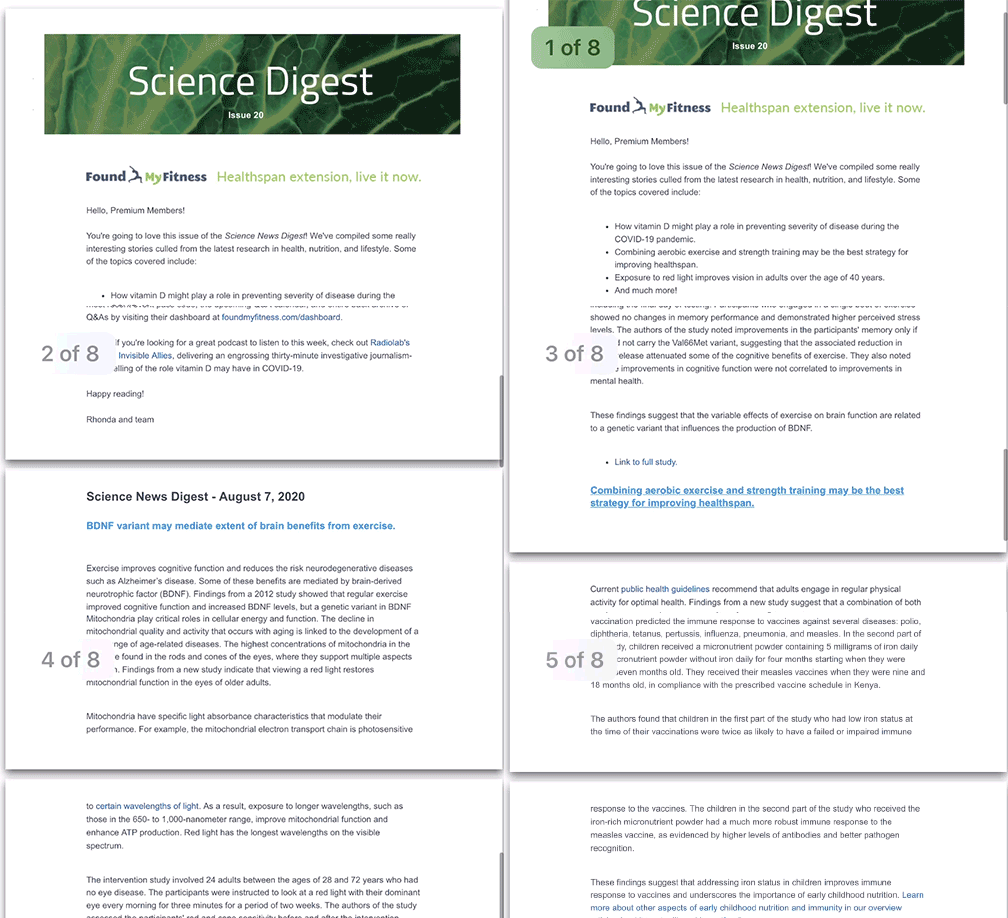
Every other week premium members receive a special edition newsletter that summarizes all of the latest healthspan research.
Rhonda News
- Zinc metabolism and possible links to Rhonda's hypothesis re impaired maternal Treg function affecting ASD
- FoundMyFitness
- Semi-regular chronic headaches or headaches and ibuprofen/advil/non prescription pain medication.
- Eating micronutrient/fiber-rich bar 2x/day increased metabolism & decreased inflammation in obese w/out diet change.
- Brian Mackenzie & friends interview Dr. Rhonda Patrick about micronutrients, hyperthermic conditioning, & performance.