How Creatine Dose Shapes Muscle and Brain Benefits
The Omega-3 Supplementation Guide
A blueprint for choosing the right fish oil supplement — filled with specific recommendations, guidelines for interpreting testing data, and dosage protocols.
You'll also receive updates from Rhonda & FoundMyFitness
In this clip from Dr. Rhonda Patrick's appearance on The Peter Attia Drive, she and Dr. Peter Attia discuss creatine monohydrate as a buffer for rapid cellular energy demands. Creatine supports repeated high-intensity work and can increase training volume, strength, and lean-mass gains when paired with resistance exercise. Daily maintenance doses of 3 to 5 grams are well established for raising and sustaining muscle creatine stores. [1]
The brain also uses the creatine-phosphocreatine system. A meta-analysis of 16 randomized trials involving 492 adults found benefits for memory, attention time, and processing-speed time, with creatine monohydrate used across the included studies. The findings support further study of dose, baseline diet, age, and energetic stress as factors that may shape cognitive response. [2]
High energy demand is a promising research setting. In a randomized crossover study of 15 healthy adults undergoing 21 hours of sleep deprivation, a single 0.35-gram-per-kilogram dose changed cerebral energy measures and improved selected cognitive outcomes. A separate eight-week pilot gave 20 grams per day to 20 people with Alzheimer's disease, increased measured brain creatine by 11%, and observed improvements on several cognitive tests. [3] [4]
This clip is excerpted, with permission, from Dr. Rhonda Patrick's appearance on The Peter Attia Drive. Thank you to Peter Attia MD for allowing us to share it.
- ^ Kreider, Richard; Almada, Anthony L; Kalman, Douglas S.; Antonio, Jose; Ziegenfuss, Tim N.; Wildman, Robert, et al. (2017). International Society Of Sports Nutrition Position Stand: Safety And Efficacy Of Creatine Supplementation In Exercise, Sport, And Medicine Journal Of The International Society Of Sports Nutrition 14, 1.
- ^ Xu, Chen; Bi, Siyuan; Zhang, Wenxin; Luo, Lin (2024). The Effects Of Creatine Supplementation On Cognitive Function In Adults: A Systematic Review And Meta-Analysis Frontiers In Nutrition 11, .
- ^ Gordji-Nejad, Ali; Matusch, Andreas; Kleedörfer, Sophie; Jayeshkumar Patel, Harshal; Drzezga, Alexander; Elmenhorst, David, et al. (2024). Single Dose Creatine Improves Cognitive Performance And Induces Changes In Cerebral High Energy Phosphates During Sleep Deprivation Scientific Reports 14, 1.
- ^ Smith, Aaron N.; Choi, In-Young; Lee, Phil; Sullivan, Debra K.; Burns, Jeffrey M.; Swerdlow, Russell H., et al. (2025). Creatine Monohydrate Pilot In Alzheimer's: Feasibility, Brain Creatine, And Cognition Alzheimer's & Dementia: Translational Research & Clinical Interventions 11, 2.
Dr. Peter Attia: Our current thinking is to take five grams every day and then you should be all right.
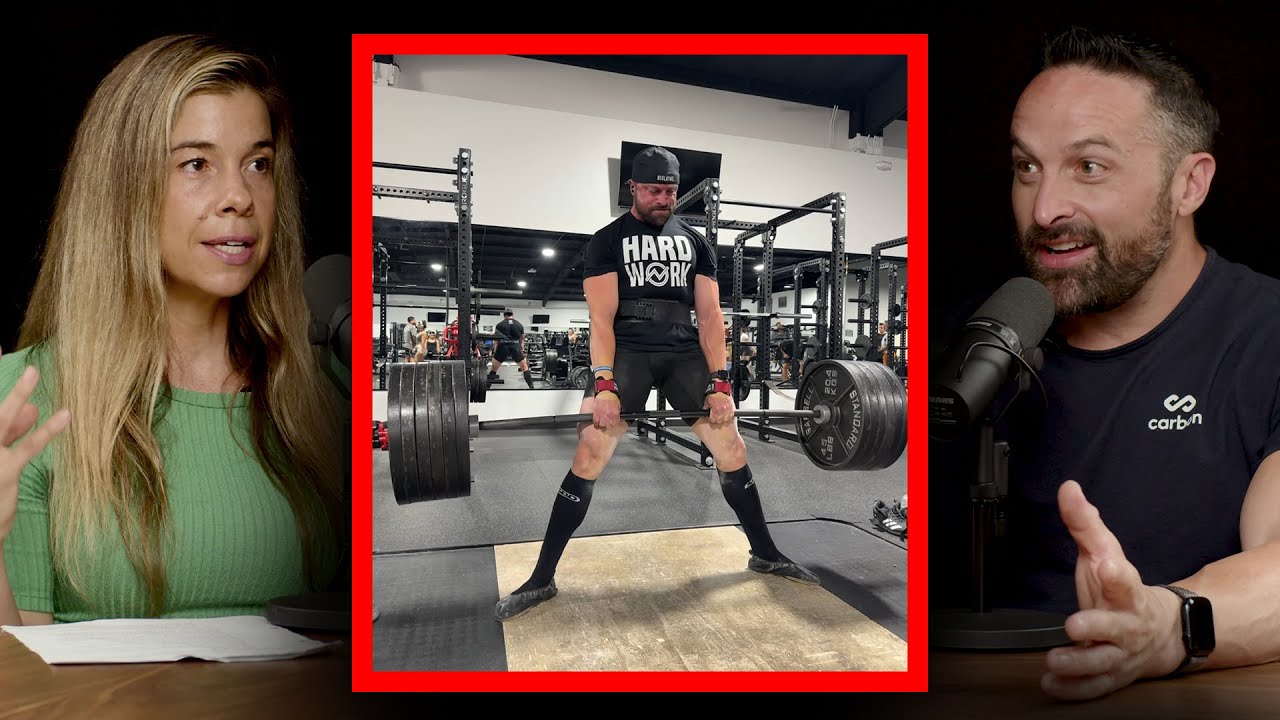
Dr. Rhonda Patrick: That was my thinking until a few months ago. For the last year and a half, I had been taking about five grams per day. The evidence shows that creatine improves exercise performance by helping you do one or two more repetitions and increasing training volume because you recycle energy more quickly. That additional work produces gains in muscle mass and strength. Creatine does not act like protein or increase muscle protein synthesis if you are sedentary.
Dr. Peter Attia: You have to do the work.
Dr. Rhonda Patrick: Right. Muscle mass and strength increase because you can perform more work. The effect was obvious for my CrossFit training because it includes explosive leg exercises and high-intensity intervals. Placebo effects may also contribute to what I noticed.
I then became interested in studies of brain health, neurodegenerative disease risk, and safe ways to improve cognitive function. I had watched the brain literature develop for years, even before I used creatine. Once I began taking it, I decided to study the topic more deeply.
Dr. Peter Attia: Did you become interested because you felt a difference, or because you were already taking creatine for muscle and wanted to examine the cognitive science?
Dr. Rhonda Patrick: The muscle literature was already clear and consistently showed benefits.
Dr. Peter Attia: Few interventions produce studies that consistently point in the same direction. With creatine and physical performance, the question is usually the magnitude of the effect rather than its direction.
Dr. Rhonda Patrick: Exactly. About 40 years of research provide a lot of data. The brain also makes creatine, perhaps one to three grams per day, but the research on supplemental creatine and the brain is newer. Many studies are small, so they are not the final word, but I expect more data to emerge.
Dr. Peter Attia: Physical-performance studies have strong objective measures. A 12-week study can determine whether hypertrophy or performance increased. How do we measure cognitive effects, and which data have increased your confidence?
Dr. Rhonda Patrick: Dose is important. Early studies found that five grams per day did not seem to increase brain creatine.
Dr. Peter Attia: Creatine crosses the blood-brain barrier. That is established.
Dr. Rhonda Patrick: It does, but muscles take up a large share.
Dr. Peter Attia: Especially if you are training.
Dr. Rhonda Patrick: Yes, although creatine enters muscle even without training. A German dose-response study measured creatine levels in certain brain regions.
Dr. Peter Attia: Did the researchers use isotope-labeled creatine rather than cerebrospinal-fluid levels?
Dr. Rhonda Patrick: I believe they used an isotope, although I do not remember the method exactly. Ten grams was the dose at which brain creatine began to increase.
Dr. Peter Attia: Does that mean cognition studies can produce mixed results if some used five grams and were underdosed?
Dr. Rhonda Patrick: Exactly. Dose matters with supplements and drugs. Context also matters. In muscle, creatine supports the extra work produced during training. In the brain, its cognitive effects become especially relevant during stress, including sleep deprivation, psychological or emotional stress, aging, and neurodegenerative disease.
Dr. Peter Attia: Anyone listening who is not under stress should tell us what they are doing.
Dr. Rhonda Patrick: Even studying scientific literature is a form of mental stress because the brain consumes a great deal of energy.
Dr. Peter Attia: The brain uses about 20% of total energy while weighing less than 2% of body weight.
Dr. Rhonda Patrick: That helps explain why extra creatine, which recycles energy more quickly, could help when the brain is under greater demand. Cognition studies measure processing speed, memory, and related test batteries. Creatine appears most useful in stressful settings, including aging and sleep deprivation.
Several sleep-deprivation studies used weight-based doses totaling roughly 20 to 25 grams. Creatine prevented some expected cognitive deficits and improved processing speed above baseline. The study was small, so it is one part of a developing literature.
Dr. Peter Attia: Who is leading this research? Creatine is inexpensive and ubiquitous, so there is little intellectual-property incentive. It would be useful to quantify the effect size and identify which people might benefit from doubling a five-gram dose. Every added health task carries a practical cost, even when the intervention is simple.
Dr. Rhonda Patrick: Darren Candow is moving into brain research after working on muscle. Several muscle researchers are collaborating with neuroscientists, and the field is expanding.
Dr. Peter Attia: This sounds like work for Dom D'Agostino.
Dr. Rhonda Patrick: It does.
Dr. Peter Attia: We should talk him into doing it.
Dr. Rhonda Patrick: There was also a pilot study in people with Alzheimer's disease who received 20 grams of creatine. The study reported improved cognitive function, and the same patients later exercised and improved strength and lean body mass.
Dr. Peter Attia: I still think prevention is the central goal. Alzheimer's disease can involve inflammatory, lipid-mediated, vascular, and metabolic pathways. The most important but hardest question is whether providing a substrate that supports ATP production 10 or 20 years earlier could help a person who is susceptible to the metabolic pathway.
Dr. Rhonda Patrick: Prevention is the goal, but many people already have parents with Alzheimer's disease and want ways to help them. Brain effects are the most interesting area of creatine research to me right now.
I take 10 grams per day. During sleep deprivation after returning from China, I took 15 to 20 grams per day.
Dr. Peter Attia: Can 10 to 20 grams in one dose cause gastrointestinal side effects?
Dr. Rhonda Patrick: A single dose could cause problems for many people, so I use five-gram doses. I mix five grams into water or tea, usually before noon. I do not become sleepy in the afternoon when I take the higher amount, although that personal effect could reflect bias or placebo.
Dr. Peter Attia: If the placebo effect works for you, that still produces a physiological benefit.
Dr. Rhonda Patrick: I expect evidence for brain benefits to grow and think 10 grams may become the new baseline.
Dr. Peter Attia: Outside jet lag, you take two five-gram servings for a total of 10 grams per day.
Dr. Rhonda Patrick: Correct.
Dr. Peter Attia: What should people look for in creatine brands? Does Creapure matter?
Dr. Rhonda Patrick: The most important point is to use creatine monohydrate. People like Creapure because of its purity. I place even more value on NSF certification because it includes rigorous testing for lead, heavy metals, and other contaminants. Creapure can also be part of an NSF-certified product.
Dr. Peter Attia: Creatine gummies are popular, but third-party testing found that many contained little or no creatine.
Dr. Rhonda Patrick: Testing found essentially no creatine monohydrate in 95% of the tested gummies. Manufacturers have told me that it is difficult to put active ingredients into gummies, and heat during production can degrade ingredients. I would avoid a gummy unless third-party testing confirms that it contains the labeled amount.
Dr. Peter Attia: A five-gram serving of powder is large. It would require many gummies, adding unnecessary sugar and affecting the teeth.
Dr. Rhonda Patrick: Powder is the practical form. Capsules also require many pills to supply five or 10 grams.
Vegetarians and vegans are another important group because dietary creatine comes mainly from animal foods.
Dr. Peter Attia: Several of my vegan friends experienced much larger effects from creatine than I did. For some women, it changed how they felt dramatically.
Dr. Rhonda Patrick: How long had they been vegan?
Dr. Peter Attia: One had been vegan for about two years and another for most of her life. The person who had been vegan for two years may have noticed a contrast with how she felt before becoming vegan, although there are many possible confounders.
Dr. Rhonda Patrick: She also chronically restricts calories, and I do not know how much protein she was eating before. That is a good...
Get email updates with the latest curated healthspan research
Support our work

Every other week premium members receive a special edition newsletter that summarizes all of the latest healthspan research.
Creatine News
- Gut bacteria may help creatine reach the brain and support its antidepressant effects.
- Creatine supplementation does not influence hair growth or hormone levels even after three months of usage, undermining theories of its potential link to hair loss.
- Creatine improved bench-press strength and increased lean mass even without structured exercise in middle-aged adults.
- Creatine strengthened cancer-fighting immune cell activity and reduced tumor growth in a mouse melanoma model.