Q&A #22: Alcohol and Longevity—Plus Zone 2 Training

Get these episodes in a convenient podcast format.
These live recorded Q&A episodes make great companion listening for a long drive. You can find these Q&A episodes alongside great interview aliquots and other special members-only episodes on The Aliquot, our official premium FoundMyFitness podcast.
Dr. Rhonda Patrick answers audience questions on various health, nutrition, and science topics in this Q&A session.
-
Introduction
-
Fish oil supplementation
-
Q: Does eating meat cause inflammation?
-
Unprocessed and red met is associated with colorectal cancer. 1
-
-
Inflammation worsens autoimmune disorders but it is unknown if inflammation causes autoimmune disorders.
-
-
Q: How does alcohol consumption affect cancer risk, lifespan, and healthspan?
-
Alcohol consumption increases the risk of many types of cancers in a dose-dependent fashion. 1
-
-
-
Epidemiological studies show that there is a U-shaped relationship between alcohol consumption and blood sugar. 1
-
-
Q: What are your thoughts and experience with zone 2 training?
-
Exercising at a moderate intensity for 150 minutes/week decreases all-cause mortality by 31%. 1
-
3 weeks of high-intensity interval training on a stationary cycle increases mitochondrial capacity by 49% in younger people and 69% in older people. 1
-
Q: What are your thoughts on the different COVID vaccines?
-
-
Rhonda's personal experience with vaccines during pregnancy.
-
Q: Does it matter if omega-3 is from fish oil or krill oil, phospholipid or not, triglyceride or ethyl ester?
-
Q: Are there any considerations in using saunas for people with metal implants?
-
Q: Dr. Satchin Panda talks about maintaining lean muscle mass while fasting using a "moderate fat" diet. I'm wondering if you know what his definition is?
-
Q: How do you brew your coffee? Any thoughts on how to get maximum benefits and decrease risks of carcinogens etc.?
-
Filtered coffee is associated with a 15% lower all-cause mortality, 12% lower heart disease risk in men, and 20% lower heart disease risk in women. 1
-
Italians that drank 3-4 espresso cups (30 ml) per day had a 28% lower all-cause mortality and those that drank more than 4 espressos per day had a 15% lower all-cause mortality. 1
-
Rhonda's experience with managing bed temperature during sleep to align with her circadian rhythm.
-
Q: Given that broccoli sprout extract is expensive, growing is a hassle, and the highest concentration of glucoraphanin is in the seeds, what about eating the broccoli seeds?
-
Q: Time-restricted eating: does taking supplements break a fast?
-
Q: Does tea or black coffee break a fast?
-
Q: How often should a glucose monitor be calibrated?
-
Q: What is your take on powders, super greens, and super reds?
-
Q: What are the reasons for abnormally high vitamin D levels?
-
Q: When our cells divide do the new cells contain only DNA information or do epigenetics transfer as well?
-
What are your thoughts on cod liver oil, PQQ, and Astaxanthin?
-
Rhonda's experience with the Eight Sleep cooling mattress.
-
Q: Where do you buy your salmon roe?
-
Q: How important is Omega-6 to Omega-3 ratio in the foods we eat?
-
Q: What is a reliable resource for third-party testing of supplements?
Hi everyone, welcome to number 22 of our Crowdcast series. So this is the 22nd Q&A that we've done. Pretty exciting. For those of you that are new to this Q&A format, typically everyone submits questions via the Crowdcast website, and I choose the questions based on a variety of factors. I look at the top voted questions, I look at questions that haven't been answered before that I think are interesting, and also questions that I've heard a lot of before, I've gotten a few times, and I know people are interested in hearing the answer to. I usually do a couple of deep dives Where we kind of go into great detail on a couple of the questions. And then towards the end of the Q&A session, I do some rapid-fire questions. So these are answers that are pretty, pretty straightforward and short.
Also, I like to take some questions live in the chat. I did notice that a lot of people already submitted questions in the chat. So just to keep in mind, Submitting the questions in the question area where it says ask a question is the best place to submit the questions ahead of time. And really, I really like to get the questions early, so, so the sooner you submit the question, the more likely I'm going to see it earlier and, and choose it. Also, if I don't get to your question, Don't worry, I archive these and I do go back and answer questions from previous Crowdcasts. So I've done that quite a few times. For those of you that want to have a replay, you can replay the video. We send that out via a summary email.
You can also access that on the Crowdcast site, and you can also listen to the Q&A in your private podcast feed. If you haven't downloaded that yet, please do. You can find that on your website dashboard at foundmyfitness.com/dashboard. So make sure that you have downloaded that private podcast feed because that's where all the aliquots come. Aliquots are our mostly weekly episodes we release, and, um, I've gotten a lot of really great feedback from them. So hopefully you guys are taking advantage of that. Awesome podcast. So before I get into some of the, a couple of the deep dive questions, I do see just a few questions here in the chat that I can briefly sort of address. So John asked about fish oil supplementation. And, you know, I obviously don't have any recommendations.
None of, none of the information given in these, in these Crowdcast Q&As should be taken as medical advice. I am not a medical doctor, I'm a scientist, and what I'm doing is just summarizing the literature and giving some of my own personal anecdotes. So, you know, anytime you're making a change, dietary change, supplements, make sure you run that by your physician. The literature seems to suggest anywhere between 3 to 4 grams of omega-3 is is ideal. So I personally, I personally do that. I do 3 to 4 grams. Sometimes I do actually up to even 6. So that's, that's kind of what my preference is. Someone else, Maria, was asking about a vegetarian source of omega-3 algae.
And so far, one of the, the problem with the, with the algae and microalgae supplements is the dose of DHA and EPA are quite low, at least relative to what you would find in fish oil. But one of the higher doses I've seen out there is from Nordic Naturals, the Algae Omega. Don't have any affiliation with Nordic Naturals, but that's one of the few brands for algae that I've seen with a pretty decent dose. There's quite a few questions about fasting and prolonged fasting I see here in the chat. Um, just a heads up, I am— so yeah, I did record a Clubhouse chat with Dr. Satchin Panda this last Wednesday, and that will be, that will be going on the podcast feed very soon, both on the private podcast feed for members as well as the public podcast feed, iTunes, or whatever your favorite podcast player is.
And I think we're also going to release it on YouTube as well. We did cover some TRE questions, but I'm also having an in-depth discussion with a fasting expert towards the end of this month. And so I'm sort of archiving some of these questions, and I think some of them are great questions that I will ask Dr. Mark Mattson. So stay tuned for a lot more on fasting. So let's get started with the first question that's a deep dive question. And this question I've gotten in some form or another many times. The question was submitted by Rebecca registered dietitian and— or she's RDN, sorry, Rebecca, RDN. She asks, with autoimmune diseases on the rise, there's a lot of buzz around anti-inflammatory eating.
Harvard Health lists red meat including steak and burgers as inflammatory food that should be avoided. She says, we've talked a lot about the nuance surrounding meat's correlation to cancer risk. What does the evidence say when it comes to inflammation? So just as a brief recap with respect to the meat consumption and cancer risk, there have been quite a few observational studies that have found a strong association between meat consumption and increased colon cancer risk, particularly colorectal Colorectal cancer is a really big one, and in fact there's been colorectal cancer for every 50 gram portion of processed meat. Processed meat, the increase there's an increased risk of colorectal cancer by about 18%.
Nitrites are present in processed meat, and we're going to talk about this in a minute. Nitrites can form nitrosamines, which are carcinogenic. You— there are variety, you know, a variety of brands of processed meats that you can buy that do not have added nitrites in them. Uh, but generally speaking, a lot of people just buy, you know, processed meat that has nitrites. And so when you're looking at this, these observational studies on processed meat, they're often skewed towards processed meat that has nitrites in them. But again, these are correlations. There's no causation established. And in fact, there have been now multiple larger observational studies done that have looked at the correlation between meat intake and cancer risk. And the correlation is there.
However, when you correct for other confounding factors, other unhealthy lifestyle factors, that risk goes away. In other words, people that are not obese, people that are not sedentary, so they're physically active, people that don't smoke, people that don't consume excess alcohol, those individuals that are quote unquote healthy and eat red meat have the same cancer risk as people that don't eat meat. And so that's a really, really big caveat with respect to cancer. That's all I'm going to say there because the question really is asking about the— if there's any— what the data says about meat consumption and inflammation.
Because meat consumption is really hugely associated with the colorectal cancer risk, there have been a lot of theories out there that— and colorectal cancer is known to be a disease of inflammation in the colon. So there's been a lot of theories out there that meat consumption does increase inflammation. Observational studies have shown an association between inflammation and processed meat. However, in those studies, those who ate processed meats also had diets high in sugary soft drinks, refined grains, refined carbohydrates. They had diets that were low in vegetables, low in polyphenols.
So it's really hard to decipher whether or not it's the processed meats that are causing inflammation in the gut, which is quite likely, quite possible, or if it's the sugar causing inflammation in the gut, which is also definitely quite likely, or the lack of vegetables, you know, fermentable fibers, which can cause inflammation in the gut, which is also likely. So I think there, you know, there's a, there's a possibility of You know, combining and compounding effects here with these observational studies, it's hard to untangle and say and pinpoint just one thing and say, oh, it's, it's the processed meat that's causing inflammation in the gut. Well, there's too many other factors going on as well.
Randomized controlled trials have shown that lean, unprocessed meat does not cause or does not raise biomarkers of inflammation. So that's obviously short-term data, but it still has a very big strength of being a randomized controlled trial that is able to establish causation. In this case, there was no causation. There was no link between healthy, lean, unprocessed meat and an increase in inflammatory biomarkers. A meta-analysis published in 2020 compiled the results of 24 randomized controlled trials that looked at the effect of red meat on inflammation or inflammatory biomarkers and glucose control. They grouped the data based on diets with more than half of a serving of red meat per day compared to those with less than half of a serving, and this was a total duration of 4 months.
These studies were for a total duration of 4 months. What the meta-analysis found was that there was no difference in blood glucose levels, in insulin sensitivity, in HbA1c, which is a biomarker of long-term blood glucose levels, or inflammatory biomarkers as measured by IL-6, TNF-alpha, and C-reactive protein. However, a majority— in a majority of these studies, again, it was lean, unprocessed meat. So The question still remains, is it the processed meat that is sort of skewing all this data towards cancer risk, towards also increases in inflammatory biomarkers as well? Another thing is this meta-analysis looking at the 24 randomized controlled trials was funded by the pork industry, which doesn't necessarily mean anything. I mean, scientists are very hesitant about falsifying data.
I mean, that's, that's, that is, that's their job. Their job is at risk. I mean, that's, that's a huge factor, but also just integrity. I mean, you know, most scientists are trying to understand how something works. And, um, so, but it still would be nice to kind of have independent funding sources at the end of the day. A cross-sectional study using 24-hour dietary recall found that, again, unprocessed red meat was not associated with increased inflammatory biomarkers or increased inflammation. Processed meat has had mixed effects on inflammation. So high intake of processed meat was associated with a significant increase in IL-6. And a non-significant increase in C-reactive protein. However, it showed a significant decrease in another inflammatory biomarker, TNF-alpha.
Data from the Nurses' Health Study 2 showed that processed and unprocessed red meat was associated with increased inflammation. However, after adjusting for BMI, the association went away, suggesting that higher BMI or people that have more fat mass is a stronger predictor of inflammation than red meat consumption. Again, that's— you can see there's a lot of nuance when it comes to observational studies. There's the question also, the question submitted by Rebecca also sort of alluded a little bit to autoimmunity, and autoimmunity causes inflammation within the body. It's currently unclear if inflammation itself can cause autoimmunity. Once someone has been diagnosed with an autoimmune disorder, you know, keeping inflammation at bay is important for sure.
So there's really 2 well-known scenarios where specific foods can cause inflammation and that can basically result in the progression of a disease, and those are gout and celiac disease. Gout happens when too much uric acid builds up in the body and the uric acid crystals form and deposit in the joints, and this attracts immune cells into the joints causing a very painful inflammatory reaction. Gout is also kind of a pseudo-immune disease because it's not caused by antibodies targeting your own tissue as you find in other autoimmune diseases. Celiac disease is an example of classic autoimmunity where the body forms antibodies against otherwise benign substances, and this is the case with gluten and grains.
Gluten insensitivity is different from celiac disease in that it is not an autoimmune disease. Symptoms are worse when people with gluten sensitivity eat gluten, but there is no inflammation associated— associated with it. Other than those 2 well-known examples, there's really not a lot known about how diet affects autoimmune disorders in terms of causation. But of course, there's a lot of data suggesting that diet can help improve symptoms of autoimmune disorders like multiple sclerosis, for example, ulcerative colitis, Crohn's disease, things like intermittent fasting, prolonged fasting, omega-3 fatty acids, vitamin D. These things have all been shown to play a role in improving some of these autoimmune diseases. Moderate alcohol consumption as well.
Refined sugar may actually exacerbate. In fact, in some cases even increase the risk of certain autoimmune diseases like rheumatoid arthritis. But honestly, I think any sort of dietary change from a standard American diet would likely result in an improvement in inflammation and in. autoimmune sort of disorder symptoms. Wee Worm is asking in the chat, what makes a meat processed? The nitrite? Processed meat is essentially when you're like combining a bunch of meat parts and you're making something else like bacon or lunch meat or hot dogs. Um, you're not just, you're not just getting like the, the raw, like the, the, the raw muscle meat, you know, like you would if you're like having a steak or hamburger. Nitrite is not necessarily what defines processed meat.
It's what, it's a defining feature of it. And now there are a lot of processed meats that don't have that defining feature because of what science has shown about nitrites and how nitrites form nitrosamines, and nitrosamines damage DNA and are considered carcinogens, particularly, particularly in the colon, in the gut, where they're, they're, they're, they're contacting, you know, the gut epithelial cells. And so a lot of processed meat companies are now making bacon without nitrites, for example. They're making them without— they're making lunch meats without nitrites. You can buy them without nitrites. The question is, well, is that healthier or, you know, is the association between processed meat and inflammation, processed meat and cancer risk, does it all boil down to nitrites?
Well, we don't know. I mean, that's one potential mechanism, but until there is, you know, an observational study that has now only looked at people consuming processed meat without nitrites, you know, then we won't really know. At the end of the day, it's, it's still sort of a risk. So the next deep dive question I really learned a lot from, and this question was submitted by Justin. And Justin asked, can you do a quick overview and a deep dive at some point on alcohol consumption and its effects on cancer, both preventing and for people living with cancer, as well as performance and longevity? So let's first talk about alcohol and cancer risk, and be prepared, we're going to talk about a lot of numbers here.
So my apologies if you're getting overwhelmed or feel bored by the, by the numbers, but they're kind of important. So compared to people that do not drink at all, light drinkers are defined as averaging less than 1 drink per day, they have a 13% increased risk of oral cancer. Oral cancer, the lifetime risk of it for a person is 1 in 100, but that— why— that's— there's huge variation between, you know, ethnicity and different lifestyle factors. So 13% risk, increased risk of oral cancer for someone that has a, you know, already has a 1 to 100 chance of getting oral cancer. It's not a very high— it's not a very common cancer. And mostly, again, is probably found in people that are chewing tobacco and things like that.
They have a 26% increased risk of squamous esophageal cancer, which has a lifetime risk of 1 in 500. So that's even less common. However, the lifetime risk of getting either of these cancers is less than 1%. So really, even drinking, you know, even light drinkers have somewhat of a very, very, very low risk of those cancers. So essentially, drinking less than 1 drink per day is like there's not much of a cancer risk. Moderate drinkers as defined averaging 1 to 3 drinks per day, which in my opinion is a really big variation. I mean, someone that drinks 1 You know, glass of wine a day versus three—that seems to me like someone doing three glass of wines a day would be a much heavy, heavier drinker than someone doing one glass of wine.
So so moderate drinkers have a seventeen percent increased risk of colorectal cancer. So colorectal cancer has a lifetime risk of one out of twenty-five. So that does increase the colorectal cancer risk. In fact, we're going to talk about exactly what that increases it to. There's a 23% increased risk for breast cancer. Breast cancer is very common. One in eight women get breast cancer. So having a 23% increased risk on something that's already high risk is is my opinion pretty dangerous. There's a 44% increase of larynx cancer, but larynx cancer is is not very common. There's only there's a one. So, 1 in 300 people come down with larynx cancer. So, that really, um, so it's 44% increased risk of larynx cancer.
There's an 83% increased risk of oral cancer, 123% increased risk of squamous esophageal cancer. We just talked about those. So, that basically translates into a 1 in 200 lifetime risk of laryngeal cancer and a 1 in 200 lifetime risk of squamous esophageal cancer, a 1 in 50 lifetime risk of oral cancer, a 1 in 20 lifetime risk of colorectal cancer, and a 1 in 6 lifetime risk for breast cancer, which, uh, not good. That's, that's definitely not good. Heavy drinkers are defined as more than 3 drinks a day.
They have a 15% increased risk of lung cancer, a 19% increased risk of pancreatic cancer, A 21% increased risk of stomach cancer, a 44% increased risk of colorectal cancer, 61% increased risk of breast cancer, 107% increased risk of liver cancer, 164% increased risk of gallbladder cancer, 165% increased risk of larynx cancer, a 395% increased risk of squamous esophageal cancer, and a 413% increased risk of oral cancer. So really, when you start to look at the lifetime risks, what this translates to for heavy drinkers is a 1 in 100 lifetime risk of squamous esophageal cancer, a 1 in 80 lifetime risk of stomach cancer, a 1 in 50 lifetime risk of liver cancer, a 1 in 50 lifetime risk of pancreatic cancer, a 1 in 40 lifetime risk of gallbladder cancer, a 1 in 25 lifetime risk of oral cancer, A 1 in 17 lifetime risk of colorectal cancer, a 1 in 13 lifetime risk of lung cancer, a 1 in 10 lifetime risk of laryngeal cancer, and a 1 in 5 lifetime risk of breast cancer.
Really a lot of increased cancer risks as you start to get into the heavy moderate range of alcohol consumption to heavy range. So in my My take-home from from just looking at the cancer risk was oh, I definitely want to be more like a maybe you know and and I'll and this we'll get into some of the other data that's actually more positive, but certainly not more than one a day and maybe you know you're doing one a day you know a few times a week or a couple times a week you know for for alcohol. So let's let's talk about some of the other things. There's a lot, you know, well, I guess in the context of cancer, it's basically, you know, what I said, it's, it seems like high risk the more alcohol you drink. Alcohol and cognitive performance.
So alcohol does obviously pass the blood-brain barrier and it affects cognition in the short term, it's impaired, and but it also has effects on long-term cognition. So based on observational data, there appears to be a U-shaped curve for alcohol consumption and cognitive ability long-term. The largest of these studies had over 15,000 participants. They found that cognitive impairment was detected in 19% of drinkers and 29% of non-drinkers. After adjusting for potential confounders, alcohol consumption was associated with a 25% decreased probability of cognitive impairment, and this was mild to moderate alcohol consumption. So this was nonlinear. This was a U-shaped curve.
So while the probability of cognitive impairment was decreased for moderate alcohol use, there was an increased risk for daily consumption of alcohol exceeding 3 servings a day. So, again, that's a U-shaped curve and it just suggests that heavy alcohol consumption is bad, which I think most people probably know. They probably know that, you know, just as a basic fact. High alcohol consumption has also been shown to be associated with decreased brain size. Decreased brain volume, and it can be associated with neurological disorders and nutrition— nutrient deficiencies as well. So let's talk about alcohol and longevity.
So there was a Netherlands longevity cohort study that found that people that drank half a serving to 1.5 servings of alcohol per day were the most likely to reach the age of 90. Surprisingly, they were more likely to reach the age of 90 than those who did not drink at all. Alcohol intake that increased above 1.5 servings per day, then the odds of living to 90 actually decreased. And not surprisingly, binge drinking was associated with decreased odds of living to 90. And there have been other studies such as the Framingham Heart Study and the Honolulu Heart Program that have found similar results. So other aspects of health, blood sugar, there's also a U-shaped curve for alcohol consumption and blood sugar.
Moderate alcohol consumption may cause an increase in insulin sensitivity and a decrease in blood sugar in non-diabetic adults. I have continually noticed this with my continuous glucose monitoring. And it's also more prominent in women, of which I am, for unclear reasons. This is not true for heavy alcohol consumption, and also for alcohol, alcoholic beverages that are really you know sugary drinks. So really having a really sugary alcoholic beverage. One meta-analysis of 20 studies found a U-shaped relationship for alcohol consumption and the risk of diabetes. So compared with a lifetime lifetime alcohol abstainers. Men who consumed 22 grams of alcohol a day were 13% less likely to become diabetic.
However, men who consumed around 60 grams a day of alcohol had the same risk of becoming diabetic as abstainers. So again, a U-shaped curve. In women, there was a similar trend. Compared with lifetime alcohol abstainers, women who consumed 24 grams of alcohol per day were 40% less likely to become diabetic. But just like in men, those who consumed higher amounts such as 50 grams per day had the same risk of becoming diabetic as abstainers. So again, moderate alcohol consumption may be beneficial for blood glucose regulation. However, heavy alcohol consumption is the opposite.
Interestingly, with respect to autoimmune disorders, studies have shown that moderate alcohol, 2 to 4 drinks per week, is associated with a lower risk of developing rheumatoid arthritis or lupus compared to no alcoholic consumption. The mechanism is really unknown but it's theorized to be through immunosuppression. Alcohol can lead to immunosuppression, which is one reason why if you're feeling like you've been exposed to a virus, for example, or you're kind of feeling a little run down, that would not be the time to consume an alcoholic beverage. But I tend to be on the 2 to 4 drinks per week for my alcohol consumption personally. And that was sort of even before looking at this data.
I think one of the biggest take-homes after reading some of these studies was very relevant to women because breast cancer risk is so high. You know, 1 in 8 women come down with breast cancer. And some factors that are diet, lifestyle, and dietary factors that are really known to be high risk for breast cancer are obesity, big-time obesity. And alcohol consumption. Vitamin D deficiency also is associated with like a worse outcome. So people, women that are diagnosed with breast cancer that are also vitamin D deficient are much more likely to die from their cancer than women that have normal vitamin D levels.
But it really seems like in the context of genetic background, you know, women that already have a higher risk genetically for breast cancer, It's really good to keep a good BMI and to not, you know, to consume very, very light to moderate alcohol. So it's kind of one of the reasons why I also think that genetic testing using a consumer-based genetic service like 23andMe, AncestryDNA, and others that test for some of these SNPs in the genes that are really well known to increase breast cancer risk in women. I think, you know, I don't think it's a good thing for women to see a gene, an increased genetic risk, and take a really extreme measure.
But I do think it's really good for a woman who may be overweight or obese that sees that genetic risk and and then knows that the obesity is exponentially increasing her risk of getting— is taking that 1 in 8, her genetics is now taking her down to 1 in 6. And now the obesity on top of that's putting her down to like a 1 in 3 chance. I mean, that is really, you know, playing with a high— with fire, basically. So I think that it can be very motivating for women to know they have an increased genetic risk to make sure they're taking every lifestyle, diet and lifestyle measure that they can to lower that risk. So the next question was submitted by Evan. Evan says, hi, Dr. Rhonda.
Increasing research seems to suggest zone 2 training based on blood lactate less than 2 is beneficial for metabolic health and longevity. What are your thoughts and experiences with zone 2 training? Thanks. For those of you that did not catch our Crowdcast in last January, Crowdcast number 19— by the way, these should all be accessible on your dashboard, your, um, at foundmyfitness.com/dashboard, as well as on your private podcast feed. We did cover exercise and longevity in depth. And the summary, the summary for that section was that exercising moderate intensity for 150 minutes a week decreases all-cause mortality by around 31%. Exercising beyond 150 minutes per week wasn't associated with a huge increased benefit.
So exercising moderately for 600 minutes a week, for example, which is quite a bit more than 150, only had an additional decrease in all-cause mortality by 8%. So let's talk a little bit— and most of the mortality decreases, all-cause mortality decreases, were due to cardiovascular disease and cancer disease risk going down. So let's talk a little bit about zone 2 training. Zone 2 training is moderate to low intensity. With a specific heart rate range between 60 and 70% maximum heart rate. So a maximum heart rate is equal to 220 minus your age. That's how you get the calculation for a maximum heart rate. With respect to metabolism, zone 2 training causes you to burn a higher portion of your calories as fat.
Because it's low intensity, you can do it for a very long time and effectively deplete your glycogen stores. The advantage of regularly depleting your glycogen stores is that you induce more mitochondrial biogenesis when glycogen stores are low. More mitochondria allow your body to burn more fat at a higher rate, so this becomes an adaptation. But this benefit's not exclusive to zone 2 training. High-intensity interval training can also cause mitochondrial biogenesis, so One of my favorite studies to cite showed that 3 weeks of high-intensity interval training on a stationary cycle was able to increase mitochondrial capacity by 49% in younger people and by 69% in older people.
And they also measure markers of mitochondrial proteins suggesting that mitochondrial biogenesis was boosted and that sort of translated to the increase in the mitochondrial capacity. As your conditioning improves, you will see that your heart rate also does not elevate as high while doing the same exercise. Hence, it's advantageous to have a device that can monitor your heart rate in real time. So, you know, there's a lot of devices out there. I use my Apple Watch. You know, there's the Whoop and, you know, Fitbit and all sorts of things that, that can do that. With respect to the lactate, the question in the question lactate was measured was was mentioned and it being less than two. I will say this: I don't think it's necessary or even that feasible.
I know people can get lactate monitors, but it's just not necessary. So heart rate is much more accurate because then the rise— so heart— the rise in heart rate is much more accurate to measure zone 2 than the rise in lactate because the rise in lactate lags behind heart rate. And lactate levels will persist high even after heart rate goes back down. And that's because heart rate rises linearly, but lactate Rises exponentially, so I don't really find lactate to be the most predictive marker of zone two training. On a personal level, I I love doing all my runs that I do are are zone two, and running is my favorite exercise by far. I feel the best after doing it. And I also notice that I do— my body composition is the best when I'm regularly doing my zone 2 runs.
However, I still do a lot of high-intensity interval training on my Peloton bike because it's really— I do still feel great after it. And there's so many benefits to high-intensity interval training as well. Yeah. But the biggest reason I do it is out of convenience. It's just right there in my house and I can get on and off in 20 minutes. And, time-wise, as a busy mother, it's very appealing to have that just quick on and off. And, I get it done and I still feel great and it's just so convenient. So, So I do tend to do a lot of Tabatas on my Peloton bike. Okay, so let's move on to the next question, which is a vaccine-related question submitted by Sigrid. Sigrid asks, do you have an opinion about the differences between the different types of COVID-19 vaccines, Pfizer versus Moderna?
AstraZeneca, especially concerning short and long-term side effects. So I will say this: I am not a— I'm not an infectious disease expert, and I think what I'm about to say is really widely known on a factual basis. It seems to be not appreciated by some of the public that are distrustful and disrespectful of vaccines and the technology. But vaccines, when done right, can cause the eradication and certainly near eradication of an infectious disease. People should remember that. It is indisputable. Important.
Better results in compliance and rapid advances in the platforms of like mRNA technology, for example, working out, I think better our odds for a powerfully positive or even unprecedented outcome with respect to COVID-19, and I think that's really even especially true for this unique situation with the SARS-CoV-2 virus. Obviously, people react differently to all sorts of things. People react differently to medications. They react differently to food. Some people are allergic to acetaminophen. Most people aren't, you know. Some people have reactions to gluten. Most people don't. So, you know, people are different.
And so there are people that are going to have more, you know, adverse side effects to a vaccine, just as they do to food, just as they do to any other supplement, herbal supplement, you know, and medication. So, you know, but there's no Vaccines aren't exceptions. I wouldn't— long-term studies haven't really been done, you know, and most of the time you're not going to find— most of the adverse effects with vaccines are pretty much in a short-term time period. So, you know, both Moderna and Pfizer are known to basically increase the risk of flu-like symptoms 1 to 2 days after the vaccine, and that's the case for a lot of vaccines. And really, it's just a side effect of your immune system becoming active.
So it's really, you know, it's more surprising to have no effect at all than, for example, elderly individuals. They don't have such a strong immune response to vaccines because their immune systems aren't working quite as well. And so oftentimes you'll have an elderly person get a vaccine and and they won't have any flu-like symptoms, but you'll have a healthy young person get a vaccine and they'll experience more of flu-like symptoms after the vaccine. Of course, there's a risk for anyone for anaphylaxis, but the risk is so low in people that don't have, you know, a history of having anaphylaxis. There's really less data on both the Johnson Johnson and Novavax compared to Moderna and Pfizer because there's just less data on them. So Moderna, the efficacy is 95%. It's a 2-dose vaccine.
Short-term side effects that are very, very rare with Moderna include Bell's palsy, facial swelling. Pfizer, 95% efficacy, 2-dose vaccine. The short-term side effects, which are very, very rare, are arrhythmias, whole-body skin rash, and facial swelling. Again, these are the very, very rare things that are not as common as people that are feeling the flu-like symptoms. AstraZeneca, 70% efficacy with 1 dose, 90% efficacy with 2 doses. Short-term side effects, which are very, very rare, are blood clots. AstraZeneca is not available in the United States. Johnson Johnson is a one-dose vaccine. It has a 72% efficacy, and so far there's just not a lot of data to know the very rare short-term effects.
And Novavax is 89% efficacious, and it's not available in the US yet, and it is effective against the UK variant. One thing to keep in mind is that when comparing the efficacy of these different vaccines, the Moderna and Pfizer efficacy data was done before a lot of these new variants were out, whereas Johnson Johnson was— the efficacy was was, you know, measured when there were other variants. And so it's quite possible that the Johnson Johnson efficacy is similar to what Moderna and Pfizer are against the original strain. Or another way of looking at it is that Moderna and Pfizer are similar in efficacy to Johnson Johnson with respect to all the strains, potentially. We just don't know.
Also, many of the side effects are hard to monitor because it's difficult to know what is caused by a vaccine versus by chance. So for example, every day over 4,000 Americans have a heart attack every single day. So Every day, 2 million Americans are getting vaccinated. So you have every day 4,000 Americans have a heart attack, and, you know, every day 2 million Americans are getting vaccinated. Well, some of those people that were going to have a heart attack out of that 4,000 may have also gotten the vaccine, but they were already going to have a heart attack. You know what I mean? So it is until you get really, really large numbers of data, which, by the way, I mean, You know, more than 56 million people in the US have now been fully vaccinated against COVID-19.
More than 710 million vaccine doses have been administered worldwide. I mean, so there's certainly a lot of data to suggest that the vaccines are safe for most people, I would say, in my opinion. I am personally Trying to get the vaccine, it is not easy in California when you're young and healthy and don't have any pre-existing conditions. You kind of have to go show up somewhere at the end of the day or something. But I personally am hoping to get one of the one of the mRNA vaccines. I'm super excited about that technology in general. You know, one of the reasons why the vaccine, the mRNA vaccines came out so quickly. in addition to other reasons, was because the mRNA technology makes vaccines easier to produce. And so they're much— it's a much easier platform.
And so I feel like, you know, some of the good news out of this pandemic is that we are now having this amazing vaccine technology, this mRNA vaccine technology, that I think are going to make, you know, it's going to sort of revolutionize vaccines in a way. So that's, that's kind of exciting. Real Kaufman's asking in the chat, what about vaccine for pregnant women? There's limited data right now for the vaccines on pregnant women. So personally, if I were pregnant, I probably would be— I have the luxury of not having to go out I can work from home. I don't have to go out and expose myself to potential risks. So I personally would wait for more data. And also, while I am clearly not an anti-vaxxer, I am definitely not an anti-vaxxer, I am a cautious vaxxer.
I was cautious in terms of getting vaccines during my pregnancy. Mostly because vaccines, you know, there's situations where women living in the world that are pregnant absolutely should get, you know, a vaccine while pregnant, but there's also situations where it may not be necessary, like in my case, where I decided to not get the Tdap vaccine while pregnant because I wasn't sure if I was going to have a really strong immune response and, you know, was concerned about the association between, you know, women that are pregnant and get, for example, a fever or the flu, have a very strong immune response for that, you know, reason. There's an association between that and having a child with autism.
And it's, again, not very clear, and there's no evidence to suggest that getting a vaccine while pregnant will increase your chance. But there is some evidence mechanistically that kind of links the possibility of, again, we don't know how each woman is going to respond to a certain vaccine. And so you do sort of run some risk of having a pretty strong response. But it's probably not that big of a deal, to be honest. And I did wait to get my Tdap. I did it first day postpartum. And I decided, um, the reason they, they, they— my OB-GYN as well as everyone else recommends doing Tdap during pregnancy is because, uh, you want your child to be, you know, to have antibodies against the Tdap so that they don't come down with pertussis as an infant, which can be deadly.
So I chose to have every single family member that was going to see my son, they had to get that Tdap booster, which is a 2-dose shot. And I got mine postpartum because I knew I was going to be breastfeeding, and you do transmit antibodies through breast milk to your infant. It's unclear if the immunity that is transferred to them from antibodies in the breast milk is as strong as it would have been if I had gotten a vaccine, you know, while pregnant. But there is, you know, obviously there is some immunity. So I'm going to change topics, but there's a question in the chat from Mike about omega-3 in phospholipid form. And he says he hasn't heard me talk about krill oil in a while, which krill oil is in phospholipid form.
I do think, as my 2019 publication suggests, that omega-3 in phospholipid form is great for the brain. It's really important for maintaining blood-brain barrier integrity. I do think that you can make omega-3 in phospholipid form from eating fish, from eating— from taking a higher dose of fish oil, which can be converted into phospholipid form. I have not found a reliable krill oil source, and the krill oil tends to be very low in DHA. And while it is more bioavailable, you still get much, much, much more DHA and EPA from taking a higher dose of fish oil. So that's kind of why I'm— I also like to get my omega-3 in phospholipid form from salmon roe, as you guys all know. So that's a really good source of omega-3 in phospholipid form. And Aswad is asking about the form of fish oil.
Fish oil in triglyceride form is better than ethyl ester. Um, so that's also something to keep in mind. Lila asks about Nordic Naturals phospholipid omega-3 supplement. I used to take that. I took it for quite, quite some time, but it, it started to like have a really rancid smell to it. And so I stopped taking it, but it's been, it's been a few years. All right, the next question was submitted from Megan, and Megan asks, About sauna usage for people with metal implants. She has a Harrington rod in her spine for scoliosis. Is there anything with temperature and people who have metal in their bodies? So Harrington rods are made of stainless steel, but other medical devices can be made of metals like platinum or titanium.
These metals do expand under heat, but within the narrow range of physiological temperatures, this expansion is It's it's pretty much negligible. So infrared saunas could potentially pose a risk for people with metal implants. Metals will absorb infrared rays and heat up faster than the rest of the body. So if you have a metal implant, probably talk to your doctor before using an infrared sauna. With traditional saunas. You heat from the outside. You know, the ambient temperature is heating the outside air, so there's really not a risk of the material overheating. Lori asks, in aliquot number 20, Dr. Satchin Panda talks about maintaining lean muscle mass while fasting using a moderate fat diet. Since moderate means something very different to ketotarians than it does to other.
I'm wondering if you know what his definition is: 30%, 60%, or somewhere in between. So Sachin was referencing his research in that particular case in mice, and all of the mice maintained lean muscle mass with time-restricted eating despite the macronutrient contents of the diet. What he was specifying was that the normal chow mice. Actually had an increase in lean muscle mass. The normal chow mice ate diets that had 13% fat. The high-fat diet consisted of 62% of energy from fat, but also a lot of energy from sucrose as well. So that's why the high-fat diet— I like to call it high-fat, high-sugar, because for some reason in animal research they always call high-fat diet When they're trying to make mice fat, they call it a high-fat diet, but really it's a high-fat, high-sugar diet.
All right, last question before I get into the rapid-fire questions. Isabel asks, how do you brew your coffee? You've mentioned filter might be a healthier option than non-filter. Any thoughts to get maximum benefits and decrease the risks of carcinogens, etc.? I recently switched to a pour-over coffee since it does filter the coffee. I still also out of convenience use my little Via Starbucks Via packets of Colombia coffee, which you just have to add hot water to. But, but there are some lines of evidence that suggest filtered coffee is better. So filtered coffee has been linked to a 50% lower all-cause mortality, a 12% lower heart disease risk in men, and a 20% lower heart disease risk in women. That has not been the same case for unfiltered coffee.
Although drinking unfiltered coffee is not bad for most people, it is associated with elevated cardiovascular mortality in older men. This could be due to the link between unfiltered coffee and high LDL cholesterol, or it could be something unknown. So the components in coffee that raise cholesterol are the diterpenes and kahweol and cafestol. Their unfiltered brew coffee can contain around 30 times the concentration of these. Compounds compared to unfiltered— compared to filtered coffee. Filtered coffee filters out most of these compounds, but the flip side of this story is that these compounds also may have some beneficial effects such as anti-carcinogenic activity, although those studies are really limited to cells in a petri dish. Non-filtered coffee that is high in in those compounds.
For example, they're made in like Turkish coffee or coffee made with the French press or boiled coffee. Espresso contains more of cafestol and the kahweol than filtered coffee, but it's consumed in much smaller amounts. So in terms of like the LDL and cardiovascular effects, it may not even— it It may not be a problem at all. In fact, a study that was published very recently found that coffee and espresso consumption in over 20,000 Italians was associated with lower all-cause mortality. Italians that drank 3 to 4 espresso cups, which is about 30, 30 mL per day, had a 28% lower all-cause mortality than non-coffee drinkers. And those that drank more than 4 espressos per day had a 15% lower all-cause mortality. Wow.
So I think there's much more data that's needed to make definitive conclusions about which coffee brew is the best. So I'm not like super sweating it right now, but I do, I do think there may be some good evidence that the pour-over coffee or whatever your favorite method of filtering the coffee is, a good old classic coffee machine, for example, may be beneficial. So Spencer is asking in the chat if I set my chili pad to change temperature overnight to sync with my body's natural cooling and warming circadian rhythms, or do I set it to a temperature all night? I recently switched over to Sleep8, and I just was having too many issues with the ChiliPad. And so I have a Sleep8. I've got their smart mattress, which is really amazing.
And right now I have mine set to neutral throughout the night because I found with the ChiliPad, I would Often wake up cold, and that was like very disruptive to my sleep. My husband has his side of the bed set more with a circadian rhythm, so he has his bed set colder when he first gets into the bed, and then it gets a little bit gradually warmer as the night progresses. And he loves that because now he's also not waking up cold, and he was having a similar problem waking up cold. So I think as it gets warmer in the summer, I'm probably going to adopt the same protocol as my husband where I'm going to probably— right now I'm set to neutral, which is basically just making sure I don't heat up my mattress too much so that I'm not getting hot, which is essentially what was happening.
So I was getting hot. And so, but as again, as it As it becomes warmer in summer, summertime, I'm going to set my temperature lower when I initially go to bed, and then I will have it gradually go to neutral to make sure that I don't wake up cold. Some rapid-fire questions. Okay. Trace asks, broccoli sprouts hack. Given that broccoli sprout extract is expensive, growing sprouts is a hassle, the highest concentration is found in this— of sulforaphane can be found, or the precursor glucoraphanin can be found in the seeds. What about just eating the seed, eating, chewing on the seeds? Um, other people want to like grind up the seeds, you know, and basically consume them that way. What are my thoughts?
So I would say going back to the Q&A I had with the broccoli sprout and sulforaphane expert, Dr. Jed Fahey, who's also a good friend of mine, I think that his answer to this question was, was quite good. And he, he basically said that yes, the highest levels of glucoraphanin, the precursor to sulforaphane, are in the broccoli sprout seeds. Myrosinase does get active when the seed is crushed, or, you know, whether that's from your, your chewing it or from you blending it up, blending it in something. Um, the, the biggest concern with eating the seeds are Mostly too much consumption of the uric acid. However, the uric acid is omega-9, which obviously people are consuming omega-9 fatty acids.
So it's hard to know what the balance is to make sure you're not like overloading yourself with the, the, the omega-9. A lot of people may not like the taste of the seeds, but I think that it seems okay if you can handle it. If you want to chew on the seeds, it seems like that would be just fine way to get sulforaphane. Absolutely. You know, Trace asks, time-restricted eating— does taking supplements like fish oil, vitamin D, vitamin C, Break a fast, assuming there are multiple aspects to fasting that may be affected differently. For example, gut bacteria, blood sugar, autophagy. I don't think it's a big problem, honestly.
Perhaps if you're taking a really, really high dose of fish oil like I do, you're getting a lot of fatty acids, and so you may want to consume that fish oil with your meal rather than taking you know. Taking the fish oil 3 hours after you finish your last meal, right? So that would be the only sort of caveat. But, you know, if you're taking the melatonin or anything, you know, your magnesium, glycine, and things like that, like before bed, I don't think that would really even count as, you know, much breaking the fast much, even though glycine is an amino acid. I don't think it's like— I don't think it's probably doing anything really big. Janice asks, is there evidence that fasting after the age of 70 is not safe?
I, again, I'm speaking with a fasting expert later this month, and so I'm sort of bookmarking all these questions that I think would be great to ask Dr. Mattson. Lori asked that about time-restricted eating. Is there any new data that black coffee breaks a fast? What about herbal or green tea? So I just talked with Sachin again last week, and it seems as though for the most part herbal tea definitely does not Does not most likely is not a big deal. Black coffee probably should be okay, you know, particularly if it's not consumed in later in the day. The liver, you know, the liver is doing some work. So as you'll hear in this in this upcoming Q&A we did, you know, there's there's like a two to three hour lag.
And so to and to some degree, I mean, you can be really obsessive about it and go well, you know, my liver is doing some work, my gut is doing some work, and really, but it's just a little bit. know, when you're not, when you're not consuming the food, the food is the real, the real big workload. So I would not stress too much about the black coffee or the herbal tea or the green tea. Dexcom G6 is the glucose monitor that you use and you calibrate it They say you don't need to calibrate it, but you and Peter Attia say you calibrate it every day. What gives? I've noticed inconsistencies with my sensors. So you change the sensor every 10 days. And so I generally try to calibrate for the first 2 days. And I noticed that after that, it really seems to be in sync.
Sometimes I don't calibrate it when I— like, I've gotten to know my body's response so well because I've been wearing it for for so many years now that, you know, it's like I'm pretty— like, I'm in tune with like what my glucose response should be to the normal stuff. And so, um, soft— often times I, I don't calibrate it at all. But there are times when I absolutely put a new sensor on and boom, it's like something seems off and I'll calibrate it and sure enough something is off. So, um, I do think it's a good idea Particularly when you're first starting out and you don't really know your body's response to everything, like it's not locked in for you, um, you know. And again, some sensors really do— are much better than others as well.
So at the end of the day, it's always better to have good data, which means calibrate. Francisco says, Rhonda, I love your presentations, your content. Your approach style. What is your take on powders, super greens and super reds? Are they worth taking, particularly if you try to eat right? Which ones are best besides your smoothies? Do you take a powder? Um, I do not take a powder at all besides my, my smoothies is kind of my, my, my go-to. Um, I don't know that they're necessary if you're eating, eating a nice, well-balanced diet. Uh, that's, that's, you know, you're eating a nice amount of vegetables and, you know, some of these polyphenol-rich fruits and things like that might be good for travel. When you're traveling, you always, you always are lacking in micronutrients.
Again, I take a multivitamin also as insurance as well. I am not big on the powders because a lot of them have— they have green microalgae in them like spirulina or the chlorella, and those are often really often contaminated with the microcysteine toxin. It's a liver toxin. So, um, so I'm, I'm very hesitant to, to try any of those powders because they always seem to have that in them. So Chris asks, what are the mechanism— mechanisms or reasons for high vitamin D levels? My last blood panel showed 127 nanograms per mL, yet I do not supplement with massive amounts of vitamin D, nor do I go in the sun all day. Genetics is a big— there, there are, there are genetic SNPs. People are genetically predisposed to higher vitamin D levels, and some are predisposed to lower vitamin D levels.
And people with lower levels do have— do often have to supplement with a higher dose than people without those SNPs. And so genetics is a big factor on regulating vitamin D levels. James asks, when our cells divide, does the new and new cell contain only our DNA sequence information, or does epigenetics transfer as well? Epigenetics transfers as well. Michelle asks, hi, Dr. Rhonda, I've recently listened to your supplementation podcast and would like to know your thoughts on cod liver oil and astaxanthin. Is cod liver oil sufficient as the N-Pure 3 omega-3 supplements you take? What about PQQ versus astaxanthin?
I am not a huge fan of cod liver oil because in order to get a good dose of omega-3 and vitamin D, you'd be getting way, way, way too much vitamin A, which absolutely is toxic to the liver in mega doses. So I think cod liver oil Um, you know, it's kind of easy for people that like don't ever want to take any supplements and it's like a 3-in-1 kind of bang, bang, you get the vitamin A, vitamin D, some vitamin D, some omega-3. But for people that are really trying to optimize and get like, you know, for longevity, your, your omega-3 and for your cardiac health and, um, you know, inflammatory health, you're trying to get a nice dose of it, then I don't think cod liver oil is great because you'd be getting way too much vitamin A. PQQ and astaxanthin are different.
We've covered both of these supplements in previous Crowdcasts. I don't remember the numbers off the top of my head, but the PQQ I was supplementing with for a while. I still have it. I'll probably add it back in. But they are different in respects of— in respect to their mechanisms and stuff. And so I do think both might be good. Astaxanthin has some beneficial effects as well. I tend to just get mine from— I do eat a lot of salmon and the salmon roe, you know, these marine fish that have the orange kind of pinkish color. That's astaxanthin. So Ella was asking in the chat, do you use Sleep8 mattress or their Pod Pro cover? I do use their mattress, but I was— I'm totally interested.
I think the main benefit— there's like a few smart feature benefits of the mattress, but I think their Pod Pro cover is really good. So I think that you know, there's a big price difference between the two, and I totally would go with the Pod Pro mattress cover. Um, so, so that, that's my 2 cents. Mike is asking how to get a CGM. Um, we're gonna talk about this in depth in the next Crowdcast. I also have a podcast that I recorded a few weeks ago that's in post-production with Dr. Mike Snyder, and we talk about a lot about CGMs there. He's done a lot of data on that, and so we talk about CGMs there. I saw someone with a melatonin question in the chat. They were saying melatonin actually keeps them up. I think melatonin, on an individual basis, it affects people differently.
Sachin and I talked about this in the, in the Q&A— sorry, not the Q&A, the discussion we had on Clubhouse last week that we will be releasing soon. So he— we talked a lot about melatonin supplementation in that podcast. So that should be useful to To you guys that are interested in the melatonin. Elaine is asking if I have a salmon roe brand that I like. I use Vital Choice. I like their their salmon roe. I like a lot of their. I order salmon from them as well. The the wild-caught Alaskan salmon. David's asking how I calibrate my continuous glucose monitor. So I have a Precision Xtra finger prick where I— so I calibrate it with that. So that's my, that's my calibration. And there was one more rapid-fire question that I, I forgot to cover, which was submitted from Timo.
And Timo asked, how important is omega-6 to omega-3 ratio in foods we eat? Peanuts, for example, have an omega-6 to omega-3 ratio of 5,000 to 1, but I always considered them a healthy snack alternative to chips. Should I avoid them? I don't. I think the the omega six to omega three ratio has has become this like popular thing to talk about in the blogosphere, and I think the real reason behind why it's important for people to keep in mind is not because people are eating healthy whole foods. Like nuts and getting omega-6. It's because people are eating vegetable oils. They're using these vegetable cooking oils which are extremely concentrated and have lots of omega-6. And on top of that, they're not consuming omega-3.
So they're getting tons and tons and tons of omega-6 from a processed oil source which happens to be very prone to oxidation. And on top of that, they're not consuming enough omega-3, and so their ratio is completely skewed. You need omega-6. Omega-6 is a huge component of all cell membranes, including the blood-brain barrier. Like, you need to get it from your diet, but you want to get it from whole food sources like nuts, not from, you know, processed foods like these, you know, oils. And you certainly I think the more important factor in the omega-6 to omega-3 ratio, honestly, is getting omega-3. I mean, people are not getting— people don't eat fish that's like high in omega-3, like the wild Alaskan salmon. They certainly aren't taking fish oil.
And so they're not getting enough omega-3. So that is my opinion. And I can tell you that I once submitted a publication for peer review, and I talked about the omega-3, omega-6 to omega-3 ratio. And I was talking about you know how bad it is to have too much omega-6 and this and that and the ratio. And the reviewers of this paper just tore me a new one. I mean, they just slammed me with so much data that changed my mind. And now I I'm like you know this whole omega to omega-6 to omega-3 rate thing, which is like it's really big in. The keto or particularly the carnivore community because it supports their prem— their hypothesis, right? Um, they say, oh well, omega-6 found in plant foods and it's bad, that's why you shouldn't eat it, you know, you shouldn't.
And so they kind of like use this data— it's not even data, there's not even much data on it at all. It's, um, it's mostly from, from, from the blogosphere, to be honest. Um, so I think I think you really have to be careful when talking or reading about the omega six to omega three ratio. Whole foods, whole foods is what you want. You want to get it from whole foods, and again, like you need omega six. You need it. Obviously, you can also omega six also is in meat as well. So getting it from whole food sources is is the way to go, and making sure you're getting the omega three is the important. part of this ratio. Mateo is asking about a reliable place to test all these powders, vitamins, supplements, things like that.
There's 2 services I personally use when I'm checking out like a powder or something. I use ConsumerLab and there's a— I don't remember, it's like a $37 annual or something. So they, you know, I would say they don't update it that often. Mostly you're paying for an archived amount of information, but they do do a lot of third-party testing on a lot of these supplements on, um, like, you know, caco supplements and beetroot and turmeric and, um, and the spirulina and things like that. They do, they do third-party testing on those. And so you can kind of see some of their, their data.
And then Labdoor also does, uh, quite a bit, although they're a little more limited in what they're They're measuring, but those are the two services that I I tend to use when it's like a a brand that I'm not familiar with or haven't had a friend you know validate or something like that. So that's my answer. Okay, so I think that's it for today's crowdcast. Really great questions. I love the deep dives. I learned so much. I also love the rapid fire. Questions as well. Again, you can watch the replay of this video that's— that'll be accessible on your dashboard, foundmyfitness.com/dashboard.
Make sure you have downloaded the private podcast feed so you can listen to this Q&A episode, which will be uploaded to the private podcast feed, as well as the aliquots that come out and early releases of our Expert podcasts as well. Thank you everyone for all your great questions. Some of you are—I will see you tomorrow. We have a monthly hangout, Google Hangout, the first Sunday of every month. This week—I mean, this month was delayed because of Easter Sunday—but for those of you interested in that, it's a pretty exclusive group, and it's a Google Hangout where you know we're interacting with each other, and it's a discussion, and we go into great detail on a lot of personal. Health and diet stuff and science and all that kind of stuff.
So for those of you that are interested in that, you can, um, check it— you can check that out. Um, there's an upgrade— there should be an upgrade button at the, the bottom left-hand corner of your Crowdcast screen. And also just, you can change your subscription on the membership website, which you can find at foundmyfitness.com. Forward slash, um, I think it's forward slash subscribe. Um, thanks again for every— for all your, you know, time and good questions. I hope you guys enjoyed it. I will see you guys next month.
Every month, Rhonda hosts a live chat with FoundMyFitness Premium Members.
Don't miss the next one.
Watch previously recorded Q&As with Dr. Rhonda Patrick
Q&A #84: Chemical Sunscreen Safety—Plus What Rhonda Eats
Dr. Rhonda Patrick discusses sunscreen safety, HIIT & brain health, diet, omega-3s, urolithin A, sulforaphane, homocysteine, peptides, and CoQ10.
Q&A #83: Does Glucosamine Worsen Alzheimer’s Disease?
Dr. Rhonda Patrick discusses glucosamine and Alzheimer's, blood flow restriction, beta-glucan fiber, creatine, collagen, red light therapy, and curcumin.

Q&A #82: Organic Food, Pesticides & Glyphosate—What Actually Lowers Exposure?
Dr. Rhonda Patrick discusses organic produce, fasting-mimicking diets, sleep, sauna, sunscreens, red light therapy, reverse osmosis water, and fiber.
Q&A #81: Beta-Glucan vs. Psyllium—LDL Reduction, PFAS, & Gluten
Beta-glucan versus psyllium for lowering LDL, PFAS reduction, creatine and caffeine, urolithin A, exogenous ketones, IVF, Botox, and sauna.
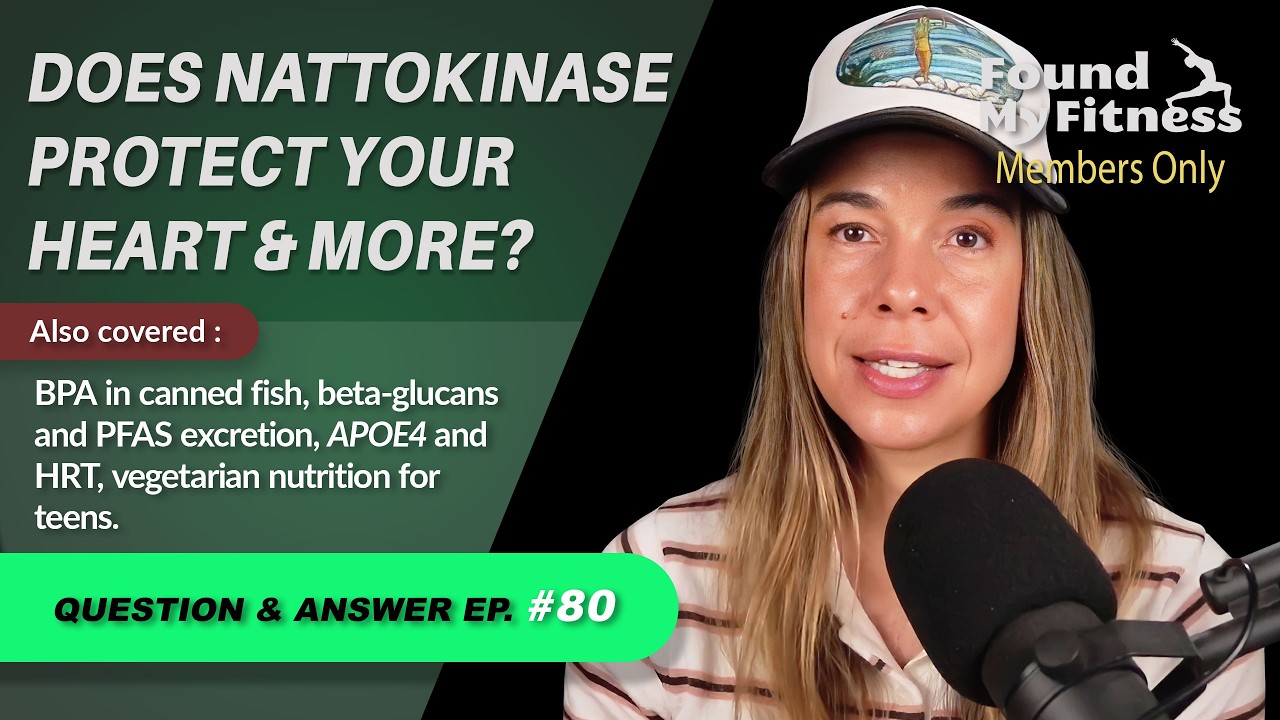
Q&A #80: Does Nattokinase Protect Your Heart?—What the Evidence Shows
Dr. Rhonda Patrick reviews the evidence for nattokinase, how oat beta-glucans may aid with PFAS excretion, and HRT for APOE4 carriers.