Q&A #23: Is Kale Healthy?—Oxalates, Thallium, & Kidney Stones
Get these episodes in a convenient podcast format.
These live recorded Q&A episodes make great companion listening for a long drive. You can find these Q&A episodes alongside great interview aliquots and other special members-only episodes on The Aliquot, our official premium FoundMyFitness podcast.
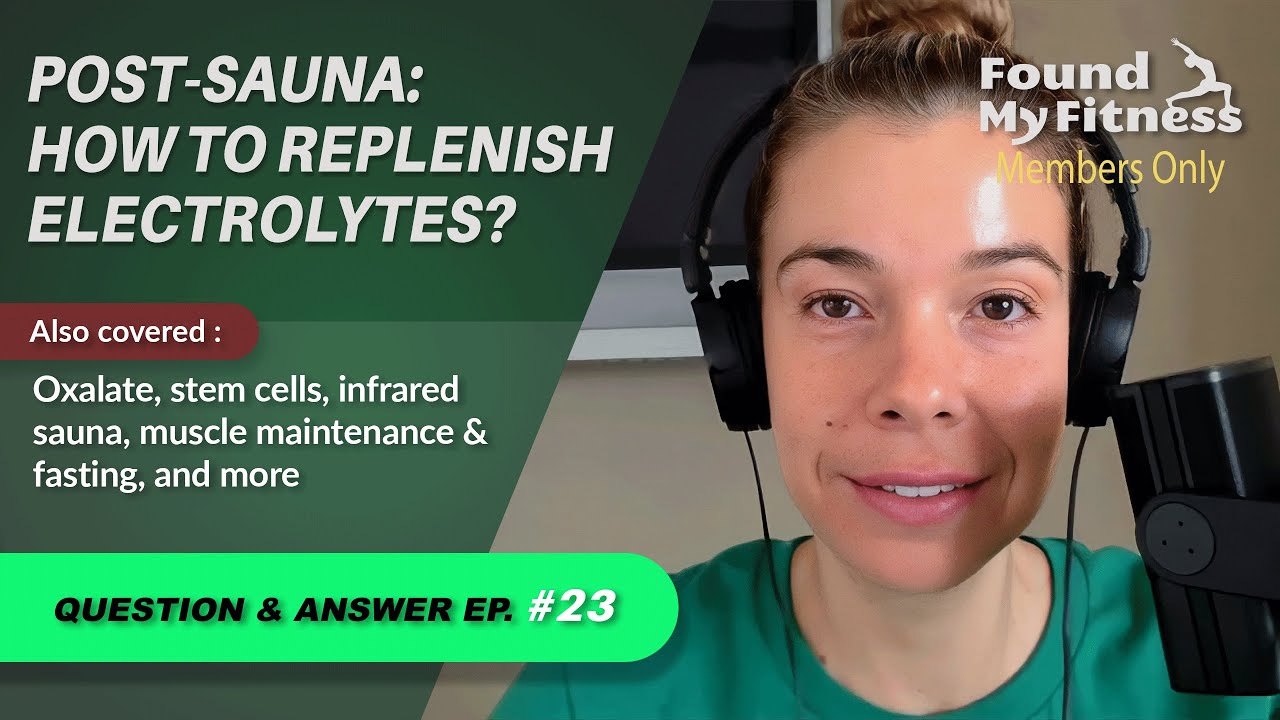
Dr. Rhonda Patrick answers audience questions on various health, nutrition, and science topics in this Q&A session.
-
Q: Is there strong evidence that kale is not healthy after all?
-
Kale has high enough levels of vitamin K1 to provide vitamin K2 benefits.
-
Dietary oxalate does not increase risk of kidney stones in most people. 1
-
Commercially grown kale does not have high levels of thallium.
-
Q: Can supplementing with iron cause toxicity and expedite aging?
-
Q: Are food sensitivity tests accurate and useful?
-
Unlike food allergy tests, food sensitivity tests are not accurate or useful. 1
-
-
Q: What are your recommendations for electrolyte replenishment after a sauna session?
-
-
-
Q: Can high blood sugar be hormetic?
-
-
Women who took 20mg of manganese a day for 8 weeks had no signs or symptoms of manganese toxicity. 1
-
Q: What is the significance of tracking the leukocyte:monocyte ratio?
-
-
Elderly rely more on the innate immune system compared to younger individuals. 1
-
-
Q: Creatine supplementation - what is the best strategy with creatine supplementation? Should I supplement with creatine constantly or does my body need a break sometimes? 1
-
Heavy resistance training while supplementing with 20 to 30 grams of creatine per day can maintain higher intensity training, increase fat-free mass, and increase endurance strength 1
-
In adults with high cholesterol, daily supplementation with 5g of creatine for 8 weeks had a 6% reduction in total cholesterol, a 23% reduction in triglycerides, and a 22% reduction in VLDL. 1
-
Q: How big a part of antiaging research are stem cells? How necessary are they beyond repairing tissues that don't heal anymore?
-
Q: Are there risks to breastfeeding babies from mothers who have received mRNA vaccines?
-
Neither mRNA from the Pfizer vaccine nor Moderna vaccine could be detected in breast milk in lactating mothers. 1
-
Q: Rhonda, what are your parenting styles? Sleep training, feeding habits, screen time, social/physical development,etc.
-
Q: When the Fasting Mimicking Diet is not an option, is a 5-day water fast still considered safe for most? Gallbladder concerns? 1
-
Rapid fire questions
-
Q: I’d like to undertake a fasting mimicking diet of 5 days with the same protocols but using fresh food. Do I need to match just the calories and macro nutrients break down or is there more going on with the fast?
-
Q: Where did you order your sauna ? What is the occupancy # for your sauna? Any special electrical outlet needed? How do you clean the sauna?
-
Q: Could you please explain what happens with growth hormone during a 3-4 days fast?
-
Q: How much time would you leave between a work-out and taking a resveratrol or vitamin C supplement so as not to risk blunting the positive effects of exercising?
-
Q: Do you think that the use of higher dose infrared sauna blankets is a good substitute for saunas or hot baths?
-
Q: I’ve been doing hot baths and it’s way harder than sauna! After 15 minutes at 106-108 degrees I can’t handle it anymore. Do you think it’s more effective than a sauna?
-
Q: Is there any benefit of getting Omega-3 DHA/EPA from fish instead of from Algae?
-
Q: Is there any reason not to take multiple forms of magnesium?
-
Q: My genetic report states that supplemental vitamin E has been shown to have a negative impact on individuals with the rs1695(A;A) genotype by raising the levels of pro-inflammatory cytokines in the blood. Could you dive deeper into why this is the case?
-
Q: What is the research behind polypodium leucotomos products for sun protection?
-
Q: Do saunas confer benefits that exercise does not?
-
Q: you discussed using predominantly kale (as opposed to Swiss chard and spinach) and blueberries (as opposed to apple and banana). I am wondering if you still include carrot, celery, lemon, and parsley, or if there might be any reason to stop including them?
-
Q: I was wondering if I could do time restricted eating when breastfeeding?
-
Q: Is there information centered on managing a longer fast if your weight is normal?
-
Q: In your last crowd cast you described the ideal range of alcohol consumption as 1 drink a couple of times a week. How much actual alcohol is that?
-
Q: I read a short item on the web saying that isothiocyanates help prevent certain diseases and that watercress has a lot. Is there anything you can say about this?
-
Q: During extended fasts can one exercise to enjoy both the uncompromised benefits from apoptosis & autophagy while selectively protecting muscle tissue?
-
Q: My wife is pregnant and had the first dose of Pfizer. We are nervous about the 2nd dose as it generally comes with the much higher immune response. Do you have any thoughts on waiting longer between doses and if that reduces the intensity of the immune response and potential negative effects of that on the fetus?
-
Q: Is there evidence to support needing 50 grams of carbohydrates a day during breastfeeding?
Hi, everyone. Welcome back to another episode of our Crowdcast Q&A series. This is episode 23. We've done 23 of these, which is pretty cool. I always enjoy doing them. I learn a lot from the many questions. I know that many of you guys enjoy them as well. So thanks for joining and thank you for your great, great questions. For those of you that are new, typically I choose questions based on ranking and also based on the question itself. Sometimes I'm personally interested in answering a question or learning more about it. Also, I'll choose a question that I've received quite a few times. I try not to be too repetitive, but every once in a while I'll go back and revisit something, especially if it's something that continues to come up.
So also I like to do a few deep dives where a couple of the questions at least I go, you know, pretty deep and we, and we talk about a lot of evidence. And then I also like to, to do a lot of rapid-fire questions where, you know, these are questions that I can answer in a sentence, sometimes even a word. So today I've decided to to really answer a lot of rapid-fire questions. Um, we're going to do some deep dives as well, but, but today I'm really— there were a lot of questions that were pretty straightforward, had pretty straightforward answers. So hopefully we get to cover a lot of the stuff you guys are interested in. So I'm going to start with the first question from Maximum, and they say, recently I stumbled on internet claims that kale is not healthy after all.
Kale contains— quote, this is a quote— kale contains the toxin oxalic acid linked to kidney stones, gout, autism. It accumulates thallium, an extremely toxic metal. It also contains K1, but our bodies need K2. Is there any strong scientific evidence to support this claim? Okay, where to start? This is, first of all, pretty much everything Everything stated in that quote is not true. It's kind of unbelievable, actually. First of all, kale is not a high oxalate plant. It's kind of funny. There are plenty of plants that do have higher content of oxalate. Kale is not one of them. Spinach is. Spinach is a high— is a plant that has a much higher amount of oxalate. But so kale is not a high oxalate plant.
Just keep that in mind because I just think it's quite funny that that's being used as an example for the oxalic acid argument. Kale has a lot of vitamins and minerals, has a lot of micronutrients in it. Magnesium—it's very high in magnesium. It's high in vitamin K1 and lutein, which is really good for the eyes and brain. Let's get to the K1 argument. The statement that your body needs— that the greens contain K1 but your body needs K2, partially correct. Yes, green leafy greens do contain K1, but in fact vitamin K1 is what is called an essential micronutrient, whereas vitamin K2 is not, and there's a reason for that.
So vitamin K1 And vitamin K2, the main difference between these 2 vitamins—they're very similar in structure—but the main difference in them is that they have different tissue specificity. And what I mean by that is vitamin K1 seems to it transports to the liver more readily, and that. The reason for that is because vitamin K1 activates proteins in the liver that are involved in blood coagulation. Vitamin K2, on the other hand, tends to stay in the periphery more, and it activates proteins that are involved in pulling calcium, transporting calcium out of the vascular system and bringing it to bones, bringing it to muscle, so bringing it to tissues that need calcium. And this has the overall effect on improving cardiovascular health because calcium can form precipitates.
And so, you know, calcium plaque buildup in the arteries and blood vessels, you know, is linked to poor cardiovascular health. So you do want to get calcium transported out of the vascular system and brought to bones and muscle and other tissues like that. However, it's very important to understand the reason why vitamin K1 is an essential micronutrient but vitamin K2 is not is because when the body gets adequate levels of vitamin K1, and this has been shown, vitamin K1 no longer gets sucked to the liver to activate these blood coagulation proteins. It stays in the periphery and does the same thing as vitamin K2. When people get an adequate level of vitamin K1, so if you're eating enough vitamin K1 is really high in dark leafy greens.
So if people are eating enough, then they're actually getting both functions of vitamin K1 and 2. However, it's also nice to have vitamin K2. There's been you know multiple observational studies that have found people that have a you know high dietary intake of vitamin K2. Have lower cardiovascular-related mortality, you know, across the board. So, and we've talked about this in previous Crowdcasts. So anyways, I know that was a little bit of a tangent, but it's a little bit of a pet peeve of mine, um, when, you know, people— I think, I think there's a big push for, you know, the, the crowd of people that don't think plants are really important to have in your diet. And, um, so they sort of want to make you think that, oh, all you need is K2.
Well, geez, you— without K1, you'd hemorrhage out at the slightest little bump, you know, um, because blood coagulation depends on vitamin K1. Um, so that's just something to keep in mind. Um, but let's go back to the other points, uh, in this question. I mentioned that kale's not high in oxalate, but let's just for the sake of argument pretend we're talking about spinach, which is a leafy green that is high in oxalate. Oxalate and kidney stones, because that's, that's kind of like the main concern. Because the most common type of kidney stone is calcium oxalate, it's been postulated that foods that are high in oxalate may increase the risk of kidney stones. But there's really no evidence to support this.
The only evidence that people really go off of are when you get these complete statistical anomalies where you have a person that is juicing 5 pounds of spinach a day every day for like a year. I mean, so that's kind of one of those, you know, outlier cases where, you know, most people aren't juicing 5 pounds of spinach every day. So, there's really just no good data support to support this. The development of calcium oxalate kidney stones has more to do with your body not being able to properly dispose of oxalate that it actually makes endogenously in the body. We actually make oxalate in our body because it's an end product of vitamin C metabolism. Vitamin C is essential. I mean, you can't live without vitamin C. So our bodies. naturally make oxalate and our bodies dispose of it.
And we'll talk about, you know, there are certain people that could be at risk, but we'll get to that in a minute. Dietary oxalates are pretty poorly absorbed. So oxalates are found in many foods and they are bound to calcium generally, like when they're in plants like spinach, for example. They're bound to calcium and that makes it insoluble. So once the— once the oxalate is ingested, calcium in the gut also can bind to intestinal oxalates and produce the calcium oxalate which is then eliminated in feces. We also have bacteria in our gut that can metabolize oxalates as well. The absorption of dietary oxalate from foods is typically around 2 to 5%.
So there's been a study that have— that's looked at radiolabeled oxalate and found that about 6.6% was absorbed when consumed in a normal diet, whereas there's a much higher risk for absorbing oxalates when it's found in black tea, for example, that has— there's no calcium complex, there's no food or other minerals complex with it. That's when there's a much higher risk. When you're, when you're, for example, example, fasting and you're consuming tons and tons of black tea. The oxalate in spinach is insoluble in the presence of calcium and magnesium, which dramatically reduce the amount of oxalate that's absorbed in healthy people to less than 5%. Also, you know, eating large amounts of greens has a— lowers the risk of kidney stones because of the high amount of potassium in them.
So in the, in the few cases where people may want to, you know, watch their dietary oxalate intake, people that are, that have like a genetic predisposition for, you know, their, their oxalate metabolism could be not working properly. People with fat malabsorption or secondary inflammatory bowel disease, celiac disease, chronic pancreatitis and a few others like bariatric surgery, maybe, um, certainly people that might have a disrupted gut microbiome, you know. So, so that would be something, uh, to consider in those, in those, you know, specific instances. And even that, I wouldn't be so concerned about, you know, having some spinach, you know, as long as you're not juicing the spinach, like juicing extremely large quantities of it, you know, every single day.
You know, it doesn't seem like it would even even should even be a concern. Oxalating gout. Gout is actually due to the buildup of uric acid crystals. It really doesn't have much of anything to do with oxalate. The reason they're sometimes mixed up is because there is some recent research research showing that some of the pharmaceutical medications that are used to treat gout may also help reduce the the oxalate levels in the body. Oxalate and autism. There is less known about how oxalate affects autism than kidney stones.
So children with autism have higher levels of oxalate in the blood and urine, but there's, there's no studies showing that low oxalate diet improves those symptoms, and there's no studies showing that having oxalate in the diet causes probably some kind of endogenous Oxalate metabolism thing going on rather than dietary oxalate. So that's kind of my thoughts on the oxalate, you know, conspiracy theory. I think a lot of people in the carnivore community like to try to use that argument why you shouldn't eat plants. I think that people like to talk about it because it's very sensational. Oh, things you thought were good for you are really not. That's always— that always gets a lot of attention and gets people attention.
And people giving health advice, well, they like attention, so keep that in mind. The other thing, um, that was addressed in this question is the thallium aspect. Uh, really commercially grown kale, like kale that's, you know, grown commercially, does not have toxic levels of thallium. There was a very sensational study that was, you know, about someone who went around testing thallium levels in kale and found that a farmer's market in the Bay Area in California had high levels of thallium. And this was an incidental finding. It was not done in a controlled scientific study. Nevertheless, you know, that kind of— that information spread and, you know, the conclusion was, oh, kale's toxic. But there's really no evidence of that.
I can tell you from— I've had my thallium levels tested, and I eat kale almost every day and have been doing so for the last, I don't know, at least 12 years, maybe 15, probably. And my thallium levels are in the normal range, totally. So if anyone was gonna have high thallium, I would expect it to be me. So those are my thoughts on the conspiracy behind why kale is Not good for you. By the way, I also like to answer a lot of questions in the chat. I do see a lot of questions related to fasting coming up. I will answer a few of those in the rapid fire. Segment in this Q&A, but I will also tell you guys that some of these questions, for example, I see Chelsea asking about how fasting may impact thyroid hormones.
I am having a very long podcast with Dr. Mark Mattson on Monday, and I will be asking him questions related to fasting in women and thyroid hormones and menstrual cycle and things like that. So So keep an eye out, that will be coming out soon. The next question was submitted by Dom, and Dom says, hi Rhonda, Professor Lithgow said on your podcast that excess iron can cause accelerated aging, but that these effects are negated with iron chelation. Iron bisglycinate is said to be chelated. Would you feel comfortable taking the Pure Encapsulations multivitamin? If it had 6 milligrams of iron in the form of iron bisglycinate. What's your opinion?
So generally, iron supplementation is pretty safe, and even, you know, regardless of whether or not it's chelated, this is because the gut does not absorb iron well if iron stores are sufficient in the body. The exception to this is people that have the genetic predisposition iron overload called hemochromatosis. And that's when your body inappropriately absorbs too much iron in the gut, and this can cause severe problems, you know, severe problems. So, you know, I think that for the most part, people that do not have hemochromatosis, that little bit of iron, 6 milligrams a day, would not should not lead to iron overload. Um, in fact, iron deficiency is very common, particularly in women that are, you know, menstruating women.
So it's very easy to do an iron overload test or a test whether or not, you know, you're iron deficient. Ask your primary care physician for that test, and that's something that's pretty straightforward to do. There's also consumer-available genetic tests like 23andMe that do test for the hemochromatosis genes. So that's another, that's another option as well. Hey Rhonda, do you think it's useful to get food sensitivity tests, and are they accurate or helpful? If yes, is there a certain type of test that would be best, the best one to try? So I did address this in Crowdcast number 18. If you would like to go back and listen or watch that episode, you should be able to do that via multiple mechanisms.
You can go to your dashboard on the— found your member dashboard on foundmyfitness.com/dashboard, where you should be able to access previous Crowdcasts. You can also listen to them on your private podcast feed, and if you have not downloaded that yet, definitely you can do that again on your member dashboard. So those are a couple of options. Again, that was Crowdcast number 18. But just kind of generally speaking, food sensitivity tests aren't really—they don't really work. Important—it's important to distinguish between a food allergy, which is when the immune system. Inappropriately responds to a foreign substance. So, you know, symptoms of food allergy are hives, swelling, itching, anaphylaxis, dizziness.
Food sensitivity or, you know, food intolerance is the inability to absorb or process certain foods, and the symptoms of that are typically flatulence, bloating, diarrhea, constipation, cramping, nausea. So they're, they're very different, a food allergy and a food sensitivity, 2 separate things. The current medical guidelines for diagnosing a food allergy starts with the, you know, history, your physical examination, and then an allergen-specific IgE antibody test. A skin prick test or a food challenge. The presence of food-specific IgG antibodies mean that the body was exposed to that food and does not mean that the body is allergic to it. So the IgG antibodies to food do not clinically correlate with food allergies.
So for example, there's been 2 studies— patients that were diagnosed with both milk and peanut allergy showed that as their allergies resolved, their IgE antibodies decreased but their IgG antibodies increased. So it's very important that IgE antibodies are tested for food allergy and not IgG, and that's pretty strong consensus between most immunolo— immunological societies, um, generally speaking. I'm going to move on to the next question, but first I'm going to take a chat question. Bella is asking in the chat, can you recommend electrolytes for post-sauna recovery? We just got an outdoor barrel sauna literally and it Because of your reports, yeah, I do think that electrolytes post a heavy sauna sweating session do help. I personally do them.
I've I use the the the no sugar noon electrolyte supplements. I'm sure there's many options out there, but but I do think because you do lose a lot of electrolytes with a with a pretty heavy sweat session that it's it's good to replenish them. The next question was submitted by by Lisa, and Lisa asked if there are any tips on lowering high oxidized LDL when the diet is already healthy. Have any specific supplements been shown to be effective? So as my shirt here, I don't know if you can see says sulforaphane. So sulforaphane actually has been shown to lower oxidized LDL.
So people that supplemented with 10 grams of broccoli sprout powder, which probably comes out to somewhere between 30 to 40 milligrams of sulforaphane a day for 4 weeks, lowered their serum triglycerides by 18.7% and lowered their oxidized LDL to LDL total cholesterol ratio by 13.5%. Overall, this reduced the trial participants' atherogenic index by 50%. So that was pretty impressive. Some other studies have shown that 1,000 milligrams of vitamin C taken for 4 weeks can lower oxidized LDL, at least in smokers. Smokers have really high oxidized LDL because they're exposing their body to a lot of oxidative stress with smoking. Other studies have shown that even just lowering total LDL can result in subsequent lowering of oxidized LDL.
There's been a lot of interesting, you know, food components that have been shown to you know, block the absorption of cholesterol and bile in the gut. So conjugated linoleic acids, buckwheat, fermented dairy products, hawthorn fruit, oats, and phytosterols have also been shown to do that. There have been some other food components that have been shown to somewhat block the production, endogenous production of cholesterol. Nothing on the level of what, for example, a statin would do, but sort of you can think of it as a similar mechanism. So, so things that have been shown to do this have been garlic, grapeseed polyphenols, red yeast rice, rice bran oil, soy, and tea. And then another way to lower LDL cholesterol is by increasing the uptake of LDL cholesterol.
From the blood into the liver, so increasing the recycling of it. And some foods that have been shown to do that, again, are conjugated linoleic acids, grapeseed polyphenols, hawthorn fruit, and soy and tea. So the next question has to do with vitamin C. It was submitted by Daniel, and Daniel asks, standard vitamin C and liposomal vitamin C are absorbed by different mechanisms and are, and are approximately independent. Taking both together leads to the, to blood levels being added. This adds the 250 micrograms per liter from ascorbic acid to 400, 400 or so by adding in liposomal vitamin C. So this is a— this was a quote that was taken from an interview from a researcher named Stephen Hickey who published a paper on the bioavailability of liposomal vitamin C. And I've read this paper before and I looked over it again.
The problem with this paper is there are only 2 subjects that were measured or this was done on 2 people. So, at this point, it's not convincing at all. So, I think there just needs to— there haven't been more studies looking at this and it hasn't been repeated in a larger You know, in a larger study. So I think that needs to be done, and the certainty of that statement is a little questionable based on just the the n of two. It's possible, you know, theoretically, it's possible that you could have an additive effect on raising your plasma vitamin C levels by taking both. Water-soluble ascorbic acid along with liposomal vitamin C. But it's also possible that enough of liposomes are going to be ruptured during digestion and your vitamin C transporters are also going to be saturated.
And so you may not have that effect. So, you know, there's really— you can make an argument against that as well. And without the actual empirical data aside from 2 people, want, you know, this thing done once, you know, there's just no way to, to know for sure. Alex asked, Can transient high blood glucose actually be hormetic, like exercise, or is it always a U-shape? I've never heard of high blood sugar being hormetic. There's really no research that could support that. The reason it doesn't seem like it would be is because humans have never had to deal with really high blood sugar, um, in an evolutionary time period. So the sweetest foods that were available to humans before Industrial Revolution and processing foods and things like that were fruit.
And, you know, perhaps honey, maybe, uh, definitely fruit. And, and, you know, those were really a luxury rather than like a staple in the diet. And, you know, it depended on the time of year which fruits were available. So people weren't really eating them all year round all the time. The body has adapted stress responses and these hormetic responses to stressors that were common, like fasting, being exposed to periods of, you know, food scarcity, exercise, having to, you know, hunt and run, get your food, or run from, you know, predators, or even just a lot of movement from picking berries or finding edible plants, things like that, and also plant phytochemicals.
So we've evolved stress responses to plant phytochemicals, but I can't really think about, you know, that sort of effect happening with sugar. So Megan asks the next question about manganese toxicity. She says, I've noticed the Pure Encapsulations multivitamins have 2 milligrams of manganese, but toxicity can happen with more than 11 milligrams, and I often get near that amount from my plant-based diet. Are you ever worried about getting too much from your food sources? So manganese is an essential micronutrient. It's needed for healthy cartilage, bones, nitrogen metabolism, mitochondrial metabolism, and wound healing. The primary source of manganese is through diet. It's also attained through drinking water, through air, through skin.
Normal ranges of manganese levels in the body Um, are about 4 to 15 micrograms per liter in blood, 1 to 8 micrograms per liter in urine, and 0.4 to 0.85 micrograms per liter in serum. The adequate intake for manganese is 2 milligrams per day, and excess manganese is excreted from the body through bile. The— there's not any great evidence that manganese toxicity can be achieved through oral consumption. In pretty much all of the cases of manganese toxicity, they occur in workers that are in mines or in factories that are exposed to high amounts of manganese through inhalation of manganese. And really, I mean, that's, that's pretty much— and there's, you know, all sorts of neurological effects that can happen.
And in fact, There's been even new studies that Parkinson's disease may also be an outcome of being exposed through air inhalation of manganese. But one study looked at mag— potential manganese toxicity from supplementation. So women who took 20 milligrams of manganese a day for 8 weeks had no signs of toxicity. So it's not really a concern I have getting it from dietary sources. So, Maxim asked an interesting question about the leukocyte to monocyte ratio and tracking it. Basically wanting to know what it means. The lymphocyte to monocyte ratio represents how much the adaptive immune system is working compared to the innate immune system.
So lymphocytes, your T cells, your B cells, these are part of the adaptive immune system and respond to infections with high specificity, minimal collateral damage. They're basically the snipers of the immune system. The monocytes, so these are things like neutrophils, macrophages, they are part of the innate immune system, and they respond in nonspecific ways to infections that result in a lot of collateral damage, and that collateral damage is what we call inflammation. They're the foot soldiers of the immune system. They basically just throw bombs everywhere. So the innate immune system is mostly what's active when your body has never seen a virus before or never seen, you know, it doesn't have any, you know, immune memory at all.
There have been— so the high lymphocyte to monocyte ratio means that the adaptive immune system is more active relative to the innate immune system. So other ratios such as the neutrophil lymphocyte or the platelet lymphocyte can also give a picture of how active the innate versus the adaptive immune system is. There have been several studies that have shown that a low lymphocyte to monocyte ratio correlates with the severity of many diseases: inflammatory bowel disease, coronary artery disease, COVID-19, sepsis. Rheumatoid arthritis, and cancer. A low lymphocyte-to-monocyte ratio means the innate immune system is more active relative to the adaptive immune system. So that's more inflammation, right? That makes sense.
For infections, the innate immune system will ramp up when the adaptive immune system is not adequately fighting an infection. So this is often seen in the elderly, where the adaptive immune system is not as robust as it used to be, which leaves them relying more on the innate immune system. Ideally, a study would measure the ratio of healthy adults and track them for 10 to 20 years to determine if this, you know, lymphocyte-to-monocyte ratio during healthy time correlates with the risk of developing a disease or death, but that study hasn't been done. But there have been a couple of studies that have looked at mortality rate and cardiovascular disease as it correlates with these ratios.
So the first study found that people with a higher neutrophil-to-lymphocyte ratio, so a higher monocyte-to-lymphocyte ratio, were 3 times more likely to have cardiovascular— and a cardiovascular event than those with a lower neutrophil-to-lymphocyte ratio. The second study found that people with those ratios suggested that higher innate immune system activity were 7 times more likely to have a cardiovascular event and 4.8 times more likely to die over a 6-year time span. So essentially it seems that at least in this— sorry, these studies were done in people on dialysis because they're routinely having blood work done blood work done. So at least in the case of people that are already sick, the high monocyte to lymphocyte ratio is not, is not good.
It's associated with a higher mortality, but it's unclear if that's the same, if the same thing occurs in people that are healthy. Um, it's not been done, so it's, it's really unknown. Yeah. But it seems, I would say, like a good theory that you would find something similar because, you know, a higher monocyte to lymphocyte ratio could indicate that your innate immune system is more dominant and therefore you're going to have more inflammation in general. Okay, I see Gal asking a question about mRNA vaccines and breastfeeding, which I'm going to address shortly. Max was asking about creatine supplementation, what the best strategy is. For someone who's lifting weights twice a week, is it is it safe? Is it safe to do every day?
If you guys haven't checked out our topic article on creatine, I would highly recommend it. It is very comprehensive. You can find our topic articles on the website foundmyfitness.com. You look in the toolbar at the top of the page. It says topics. Click on that and it'll take you to a page that lists alphabetically all the topics. It lists the popular topics. You'll find creatine there under the C section. And it's a really, really comprehensive article. So I really recommend you guys read through it. Anyone that's interested in creatine supplementation. Creatine, you know, is produced in the body. Supplementing with it has been shown to improve muscle performance and recovery.
It's been shown to slow, slow bone and muscle decline in elderly, and it's been shown to also provide some neuroprotective benefits in the brain as well. People that have participated in pretty heavy resistance training while supplementing with 20 to 30 grams of creatine per day can maintain higher intensity training. They can increase their fat-free mass, their fat-free mass, and they can also increase their endurance strength. In adults with high cholesterol, daily supplementation with 5 grams of creatine for 8 weeks resulted in a 6% reduction in total cholesterol, a 23% reduction in triglycerides, and a 22% reduction in VLDL. Super interesting stuff. For the most part, so creatine is pretty safe and well tolerated, and there is a whole safety section in our topic page.
The primary side effect of creatine supplementation could be weight gain, which might be due to the increase in muscle mass or also due to the fact that creatine supplementation can increase body water content due to the chemical structure of the molecule that is very common in supplemental form. There have been some case reports and anecdotal claims that have reported adverse events such as musculoskeletal skeletal muscle pain, dehydration, muscle cramping, GI problems, kidney problems. But there's really been no well-controlled clinical studies to confirm those. And there's also been some evidence that perhaps there, there could be some alteration of the, the dihydrotestosterone, DHT levels with creatine supplementation. There's been one study that has looked at that.
There's been no findings that have replicated that. So that's also one of those sort of open questions, but that is something that you can measure routinely in, in a lab test. So I think that people that are interested in creatine supplementation should read over the topic article, perhaps experiment with, you know, a lower dose, do some lab tests before and after. And, and go from there. So, James asks, how big a part of anti-aging research are stem cells? How necessary are they beyond repairing tissues that don't heal anymore? Are there any ways to replace adult stem cells? without having a lifetime of DNA damage in them? In other words, is there any way to have healthy, new, young stem cells?
Stem cells, their major role is to not only replace, you know, cells that are damaged or, you know, not only help repair tissues that are damaged, but they also just replace cells in general. I mean, cells have a limited lifespan and Eventually they die. Without replenishing the cell population of a tissue, you know, you'd have organ failure. So stem cells are really important for just replenishing the normal, you know, cell population within each tissue. So they are very important for normal function as well as repairing damage and, you know, repairing damaged tissues as well.
From my knowledge, one of the lowest-hanging fruits for replacing stem cells— and what I mean by lowest-hanging fruits is no genetic engineering involved, no having to inject stem cells, you know, into your brain, no, like, real hardcore technology needed— one of the lowest-hanging fruits that I am aware of in terms of being able to actually replace stem cells seems to be a prolonged fast followed by a refeeding phase. And I would say this research is also still in the early phase, mostly because it's preclinical. And as we've talked about several times, it's very hard to translate an animal study to humans, particularly with respect to anything regarding fasting, because metabolisms of rodents are so different.
So for example, you can take a rodent and fast it for 48 hours and it'll lose 20% of its body weight, whereas a human fasted, fasted for 24 or 48 hours will lose 2%. So extrapolating the time needed to fast and to get the same results from an animal study is still challenging. But what we do know from preclinical evidence is that a 48-hour fast, for example, in an animal, in a small rodent, can result in activation of stem cells up to 6-fold. And basically, during the refeeding phase, the proliferation of those stem cells and basically stem cells replenishing, not only making new stem cells but making, you know, new cells within a tissue.
You know, this is when Valter and his collaborators have shown that organs will shrink due to, you know, cells dying off, due to, you know, also due to somewhat the size of the cells shrinking as well. They shrink during the fast, and then during the refeeding phase, of which IGF-1 activation is very important, the refeeding phase will allow those stem cells to grow and proliferate. And, and the refeeding phase is very important because without that activation of IGF-1, that doesn't happen. So, um, the refeeding phase is very important and something I'm going to be discussing with Dr. Mark Mattson on Monday. So we'll, we'll be going into detail on this shortly. But that is something that I think is the most promising low-hanging fruit for humans.
Now translating that to humans is quite difficult. It is my, you know, theory that if you look at something like what amount of IGF-1 drop during the fasting phase is required to activate the stem cells, that's about a 50% drop. And that happens in about, you know, 2 days for animals. In humans, that 50% drop happens at around 5 days of no food. So it's possible that you could get something like that in, you know, after a 5-day fast. And then the refeeding again is also a big unknown. But it's also really important to have foods that are high, high in essential amino acids like methionine that activate IGF-1. So you, you know, obviously eating things like eggs and, you know, protein, and also having some fruits as well, because IGF-1, you want to, you want to have it bioavailable.
And so having, having some carbohydrates with that as well helps with that. But again, this, this is still The organs shrinking and then regrowing and stem cell activation to that degree has not been shown in humans yet. So it's still sort of a, okay, we're trying to translate a preclinical study to a clinical setting, and in which case a lot of it's just speculation. So Chelsea's asking in the in the chat, does fasting too frequently deplete stem cells more quickly? The the really important thing about the you know rejuvenation aspect of the prolonged fast. This twofold: one, the the the you know the stress from the fasting that that lowers the IGF-1 so dramatically, which then basically causes the stem cells to become active.
And two, the refeeding phase—you have to have that replenishment, the nourishment. And I think that people that, for example, are chronically calorically restricting may miss out on that because they're not. Tapping into that refeeding phase, that important replenishment, um, with, with a lot of foods and nutrients and the— and activating the IGF-1. But again, this is like a topic that I'm super excited about to go in detail with the expert, Dr. Mark Matt— Mark Mattson. So the next Question was submitted by Gal, and Gal asks, there haven't been studies on lactating women that I'm aware of to show vaccine safety on breastfed babies.
I'm trying to determine whether or not there may be risks I should take into consideration, like can I get mRNA into breast milk, or maybe there's a reason why I wouldn't want my baby to have antibodies. Against the SARS-CoV-2 virus, I guess. Any potential risks? So this is obviously something to talk about with your physician, and I certainly can't give any medical advice, but I did do a little diving into the literature and found that a very small study at UCSF found that neither the mRNA vaccines from Pfizer or Moderna could be detected in breast milk in lactating mothers that were given the mRNA vaccines. This was a preprint study, so, you know, the preprint is available, but it hasn't undergone, you know, peer review and been published in an academic journal yet.
Nonetheless, I think it's still extremely useful for lactating mothers that are desperate to find any information. Talking about from just, you know, a mechanistic standpoint, the vaccine, the mRNA vaccine itself is made of lipid nanoparticles that contain synthetic mRNA for the SARS-CoV-2 spike protein. The mRNA sequence you know, only encodes for this protein, and these lipid particles with the mRNA are injected into muscle where the nanoparticles are taken up by muscle cells. These muscle cells then transcribe mRNA, and they make proteins in the muscle cells against the SARS-CoV-2 spike protein.
The spike, the, you know, the spike protein now made inside the muscle cells stimulates the immune, stimulates an immune response, and that immune response is what protects an individual against COVID-19. During lactation, it seems extremely unlikely that the vaccine lipid injected into the muscle either an intact nanoparticle or even just the mRNA could be transferred into breast milk. Even if there was some weird thing that, you know, scientists haven't thought about that would allow that to happen, it would probably— like, it would be, you know, expected to be digested by the child and So, you know, it wouldn't have any biological effects because the child would be ingesting this nanoparticle with the mRNA. So it's hard to imagine how that could have any biological effects.
I also can't think of any reasons why it would be bad to have antibodies against the SARS-CoV-2 spike protein. There are passive antibodies that are transferred through breast milk. They're not very long-lived. In fact, maybe a month. So, you know, if you had a COVID-19, you know, one of these COVID-19 mRNA vaccines and were breastfeeding, you're not going to be continually transferring antibody, passive antibodies throughout your entire lactation period. You may be doing that for like a month. Okay. And once those antibodies are in the infant, they're also pretty short-lived. So this isn't, you know, this isn't that the infant's immune system didn't react to the vaccine itself, and so this isn't like a long-lived, you know, immune response.
These are just antibodies that have been passed through breast milk. So it's a very different situation. You know, I think that in my mind, it's Probably more dangerous if an infant actually, you know, gets COVID-19. And not even just more dangerous, I don't think it's dangerous at all for— it doesn't, you know, I can't imagine any situation where getting these passive antibodies would be dangerous for an infant. I got my first Pfizer shot last Tuesday, and I really had not had no— a little bit of arm soreness for like a couple of hours. I did some exercises and It was, it was fine, but, um, that's the only effect I had. Uh, nothing, nothing else other than a little bit of a sore arm. So. Okay.
So Drew is asking a question about spreading out mRNA vaccines in pregnant women to reduce the intensity of the immune response. There's a similar question, like, I'm gonna get to this in the rapid-fire questions, so we'll get to that soon. Hi, Rhonda. I'm curious if you could describe your parenting approach. For example, sleep training, feeding habits, screen time, social, physical development, or just a daily routine. So, I think I've discussed in a previous Crowdcast that I personally decided not to do sleep training. It was just something that I could not do. And I came up with theoretical possibilities of why I shouldn't do it. And I'm sure the, you know, millions of children that were sleep trained are just fine, but I personally did not do it.
For screen time, that's been a really, you know, important You know, part of our parenting approach, we basically have had no— we had almost no screen time at all for the first 2 years. And even now that my son is 3 and a half, we now get a little bit of screen time sort of at the end of the day. And I'm very careful about what that screen time is. There's been studies showing that screen time, so no, you know, iPads and all that, like the only time I'll do, you know, an iPad is on a, like a long flight or like a flight basically. And we haven't done those since the pandemic, but that's pretty much the only time I would do that sort of screen time.
There have been studies showing that screen time is associated with all sorts of negative behavioral outcomes in children, ADHD, definitely ADHD where the, you know, the kids, they get, you know, this dopamine reward every time they're, you know, this electronic, you know, game they're playing or, you know, watching something where it's just overstimulation and sort of they come to expect it. And then, when they're not getting that from doing something that's not so stimulating, like, you know, they get bored then move on. And so, there's a lot of ADHD associated with that. Also, Just giving your child attention, you know, is so important and is what they want. And so oftentimes, you know, parents will be busy.
I know particularly during the pandemic, since a lot of parents were working from home and then they also had their children at home, many kind of would turn the TV on as a sort of babysitter. And lots of parents started having a lot of behavioral problems, you know, with their children as a consequence of that as well. So I do think that even though it's really hard and it's very tiring, it's very rewarding. And the long-term effects on the child, it's really important, I think, to limit screen time. And I just think that the science is very strong on that. And I mean, I can tell you from experience that it is not easy. I mean, you just have to put in a lot more work, but it's worth it.
Also, I think, you know, like with my son, we didn't do like, you know, there's a lot of apps out there for reading or teaching them alphabet or, you know, all that stuff. And we just, you know, we did it the old-fashioned way with talking to him. And we started flashcards when he was really, really young, like 15 months. And he reads now. He's been reading since he was 2. He's like a— he's a very, very good reader. And that's something that we've just fostered for a long time starting from early on, just starting flashcards. You'd be amazed how children can just use even memory and how memory is also just a big part of reading instead of focusing so much on the phonetics, which also are important.
You'd be amazed by just how much having that memorization and being able to like memorize things like flashcards, it really just skyrockets their reading skills. Feeding habits, you know, I've tried my best. You know, my son has always been a picky eater and, you know, there's things that he, you know, little nuances, but the thing that I found the easiest Um, is to— like, if you're trying to get a lot of greens in them, the smoothies are the best because you can add the greens and the fruit, and you can add, you know, you can add some like protein powder, you know, whatever it is, you know, you need. You just get it all in the smoothie, and, and smoothies are pretty much universally loved.
So, um, I definitely try to, to get a lot of protein because it's important for growth, IGF-1, you know, activation and stuff like that. And then I A lot of fruits and fiber because the fruits are a great source of fiber. And so children, instead of having all the— I never did any of the packaged baby foods or toddler food, like the squeezy things and all that. We never did any of that. It was always whole foods, real foods. It's more work, but, you know, again, it's just so much better long-term. And I have my son involved in a lot of social activities, outdoor activities. We do soccer, we do T-ball, you know, swimming. So I think that starting early really gives them confidence. It gives them confidence.
It also, you know, teaches them how to play with other children in larger groups and listen to, you know, a coach and follow instructions from someone that's not just a parent, that's another, you know, authority figure. So there's just a lot of great, you know, reasons why. And then physical activity, they're getting that exercise, which has been shown even early, and particularly early in life when the brain is still developing, it actually improves cognition. It improves You know, synaptogenesis and all these things, and so you want to get your child active. So that's pretty much in a nutshell. Okay, so Greg asks about the fasting mimicking diet, or sorry, when fasting mimicking diet is not an option, is a 5-day water fast considered safe? Are there gallbladder concerns?
Um, so I will be addressing this with Dr. Mark Mattson on Monday, but I've also given this a lot of thought. Um, I've looked at the one study that has been cited by, um, Dr. Valter Longo in, um, in a review he wrote, and I know he's the one that mostly talks about this. Um, This was mostly a concern in women of reproductive age that you know they're they're at a more higher of a higher risk for gallstones. The study basically looked at the effect of overnight fasting or dieting, and whether or not that was associated with with gallstones. So during fasting, bile accumulates in the gallbladder. And the longer bile sits in the gallbladder, the more the opportunity it could have to form a stone.
So this study found that overnight fasting had a hazard ratio of 1.33 for risk of gallstones, but dieting had a had a much higher hazard ratio of 1.67. So actually, it seems as though it's not the overnight fasting that is bad. But it is the dieting that can increase the risk of gallstones, particularly because when you have less fiber and less fat in your diet, the body releases a hormone that tells the gallbladder to con— when you have that fiber and fat, the body releases a hormone that tells the bladder to contract and expel the bile into the intestine. And so you're basically not having that bile buildup.
And I think there, you know, the dieting and the overnight fast have kind of been— there's kind of a blurred effect there because a lot of these women that were doing overnight fasts are also— they're also like dieting, extreme dieting, and they're not getting enough fiber and they're not getting enough fat. And so that risk for gallstones goes up. I'm gonna get Mark Mattson's, you input on this because I'm interested in that. But in my opinion, I think that it's, you know, people that are eating a balanced diet with fiber and fat. And, you know, it's not— you're not— they're not someone that's chronically, you know, dieting and calorically restricting and just, you know, not eating a very balanced diet. I'm not— I'm not sure that there's much of a risk. Some rapid-fire questions now.
I missed a few for some reason. I skipped a few rapid-fire questions I was going to address last month, so I kind of moved those up to the top. Rich asked, hi, after completing the ProLon FMD a number of times, I'd like to undertake a fasting mimicking diet for 5 days using the same protocols but whole foods. Do you have any advice? Do I need to match just the calories and macronutrient breakdown, or is there something else going on? So basically, it's matching— it's matching the macronutrient ratios. So the fat to protein to carbohydrate ratios as well as calories. So those are the, the important ratios, and you can find those all in Dr. Valter Longo's studies. Where did you order your sauna? What's the occupancy, occupancy number for your sauna? Any special electrical outlet needed?
How do you clean the sauna? So I got my sauna from Nordic, Nordic Sauna. I just got a 2-person sauna, no special outlet needed, and you can clean it with with, with just even soap and water. Rhonda, could you explain in easy terms the correlation between growth hormone during a 3 to 4 day fast? I was under the impression that fast— during a fast, growth hormone goes down, and after refeeding, it spikes up. Sauna, on the other hand, increases growth hormone. Isn't that counterintuitive? So let's, let's talk about the difference. Growth hormone actually increases during a fast, and growth hormone also increases during a sauna as a part of a stress response. The stress response— this is that hormetic response.
This is the, the what Mark Mattson will— I know he so eloquent— eloquently explains, um, how there's an evolutionary basis for this stress response. Growth hormone release is part of that. So, so that happens during fasting and that happens during, you know, high heat like the sauna. It also happens during intense exercise. IGF-1 and growth hormone, they're not the same thing. Oftentimes growth hormone can, you know, there can be a relation between the two. But IGF-1 is what goes down during a fast, and the reason it goes down during a fast is because protein intake goes down, and protein intake, particularly certain essential amino acids, activate IGF-1. So, so IGF-1 goes down during a fast; growth hormone goes up during a fast. Alyssa asks.
How much time would you leave between a workout and taking resveratrol or vitamin— or a vitamin C supplement not to risk the— so that you don't risk blunting any of the positive effects of exercise? Typically around 10 hours. Do you think that the use of a higher dose of infrared sauna blanket is a good substitute for saunas or hot baths? I do not have access to a sauna and I just replaced my bathtub with a shower. I think that the, the personal infrared saunas with— that you can buy like on Amazon, the ones that you can like have your head out and it's like this little box that your body's in, I think those are a good alternative. So Kenny asks, I've been doing hot baths a while. I have no access to a sauna. It's way— and it's way harder than doing the sauna.
15 minutes in 106 to 108 degrees and I can't really handle it anymore after 15 minutes. Is it possible it's more effective? Water is better. I mean, your skin, your body's in contact with hot water, so it's definitely more effective at transferring heat to the body than air is. So absolutely think you would need less time than you would in a sauna. Jake W says, hi Rhonda, I would like to know If there are any known benefits on getting your— getting omega-3, the DHA, EPA from fish instead of from algae. Getting it from algae is often recently referred to as getting it directly from the source and avoiding the potential contaminants in between, and I wanted to know your opinion. Um, I think that there are some advantages from getting the omega-3 from algae, mostly on a sustainable level.
But until the concentration of EPA and DHA in algae can be somewhat comparative to what you find in fish oil, it's just so hard to get the gram amounts that I take from an algal source. I'd be wasting plastic. It'd be a whole other sustainability question because I'd be going through bottles of the algae supplements too quickly, too quickly. So, um, I think the— from, from, you know, my, my biggest concern is that it's just the concentration. I mean, it's just, it's so much lower. I mean, it's just so much lower. You're talking about something that's like, you know, 35, maybe 50 milligrams to something in, in one little pill to a fish oil capsule which is between, you know, 500 to 1,000 milligrams. So, big difference. Choosing which form of magnesium to take is maddening.
Is there any reason not to take multiple forms either separate— in separate supplements that contain multiple forms? I don't see any reason not to take multiple forms. Magnesium chloride is probably the most poorly absorbed. magnesium supplement, but like all the short-chain fatty acids magnesium forms like magnesium acetate, citrate, malate, um, those are— those are all really good. Magnesium glycinate and threonate are also good, and I can't think of any reason why it would be bad to take multiple forms. Rebecca talks about her genetic report saying that it's bad to supplement with vitamin E. And she kind of wants to know why that is.
So the main reason for that is because people that have good functioning glutathione enzymes can actually have a negative effect when people when people supplement with high doses of alpha tocopherol, like higher than what you would get from from like an RDA. So you know people that are taking like 100 IU or 400 IUs of alpha tocopherol. Tocopherol. Basically, you're, you're, you're blunting your glutathione enzymes from being activated, and glutathione enzymes are actually much more powerful at reducing inflammation than vitamin E is. So that is the reason for that. And not all tocopherols, you know, and tocotrienols are the same, you know. So, so gamma-tocopherol, for example, doesn't have that same effect.
But most of the time when you get a vitamin E supplement, it is the alpha-tocopherol form. Meredith says, hi Rhonda, love these, thank you for doing them. My question, as a fair-skinned individual who loves being outside, I'm always looking for the next thing in sun protection. And she's been looking into the Polypodium, uh, leucotis, uh, She wants to know if there's any research behind these products or whether or not it's cherry-picked or hype. I will say that, you know, there are quite a few natural compounds that can help blunt the inflammation that is generated by UV damage, and that has a beneficial effect.
However, I don't think any of them would ever be a replacement for mineral-based sunscreens that can just reflect and deflect the UV rays from actually even penetrating the skin because, you know, there's just multiple things going on and I think the best way to avoid the damage is to not have the UVs causing the damage in the first place. On a related question, Kenny asks, is it safe to do 20 minutes in the sun between 10 to 2 PM a day for vitamin D? Like, what about tanning beds? So, you know, obviously depending on, you know, where a person lives and what time of year it is, you know, in some regions of the world you won't even make vitamin D if it's winter and you're like in the UK or in Washington State, for example.
Um, but let's, you know, for the sake of argument, I do think that It's probably okay to get 20 minutes of UV radiation a day, and whether or not that's going to be adequate to maintain vitamin D levels—probably not in most in most people—but the only way to know is to get a blood test. I'm not I'm not a fan of tanning beds for sure, and you would you do have to realize that the 20 minutes in the sun a day, you will be you will be getting. Both UVA and UVB, you know, rays, and it will be, you know, it does cause skin aging, and it does cause DNA damage. And there is, there's, it's not a zero risk, basically.
But, um, you know, I do think that it's probably not like, it's not the same as, you know, people that are just sun worshiping and going out like for many, you know, hours, um, every day doing that. Personally, um, I try to— I do, I mean, I don't always sunscreen every part of my body, and I'm in the sun a lot. I'm out gardening and, you know, going for runs and stuff like that, so I definitely am getting some UV exposure, but I try to do my best, and I do take a vitamin D supplement because I don't, don't make— don't get enough vitamin D from just the sun. Does sauna use confer benefits that exercise did not. So for example, could you do 5 hours of exercise plus 4 sauna sessions per week?
Is that more beneficial than 5 hours of exercise plus 4 additional 20 minutes of exercise sessions per week? I would say that so far the evidence suggests that yes, the additional— adding the sauna is beneficial. And so there have been some studies looking at the addition of sauna use with exercise, and together, the two had an additive effect on lowering all-cause mortality and cardiovascular-related mortality than exercise alone. There have been other studies that have shown exercise, when you add even just, you know, an additional hour or so a week, that the effect on all-cause mortality, cancer mortality, cardiovascular-related mortality is It's quite low. So you take, you know, you're basically not getting much of an additional benefit.
Whereas with the studies looking at the sauna use and exercise, you are getting an additive effect. You also, you know, when you're doing the sauna, you're sweating more most of the time than like a 20-minute exercise session. I mean, unless a person is just really, you know, they're just pushing it really, really hard. But generally speaking, you'll sweat a lot more with the sauna, which has benefits in and of itself of, you know, helping to excrete a variety of, you know, metals and other compounds that BPA, you know, the PVCs and things like that that are— that we're exposed to. And also, HSP, heat shock protein activation, is very robust with sauna use. And after even just 30 minutes, it's 50% over baseline levels, which is quite robust.
You, you do also activate heat shock proteins with exercise because you're elevating core body temperature, but I do think that the sauna does it even more robustly. A few more rapid-fire questions. Stephanie asks about my micronutrient smoothie. In Aliquot episode 22, I mentioned using just kale and blueberries and basically not including carrot, celery, lemon, parsley if there's a reason to, and not using the apple or banana or spinach if there's a reason to stop them or if it's just mostly convenience. So basically, I took out the apple and banana because that was raising my, my blood glucose levels to— I mean, it just wasn't— I didn't feel like it was necessary.
And, and the blueberries do a good job making the smoothie taste great, and, and my blood glucose levels don't go up hardly at all. I use the kale instead of the spinach. I just don't want spinach every single day because, because, you know, I just— there's more— I think there's more nutrients in, in the kale. But I do include it sometimes. I do include the spinach and the kale. So it's mostly a convenience thing, what I have available. I, I see no reason why not adding celery, carrot, lemon, parsley. Those things are— they've got, you know, a diverse, you know, profile of micronutrients. And if you have them in your refrigerator, why not add them? I certainly don't see a reason why not to include them. I mostly just— it's a very convenient thing for me to quickly do it.
And it's most of the time have that stuff in my refrigerator and freezer. So Jay asks, hi Rhonda, I'm exclusively breastfeeding my 10-week-old baby. Was wondering if I could do time-restricted eating when I breastfeed. I used to do an 8-hour time eating window and it really helped me regulate my appetite, encourage weight loss. Not sure if that's safe while nursing though. I personally, while I was breastfeeding, did a 10— mostly a 10-hour, 10-12 depending on the day, time-restricted eating window. I don't think you want to The problem with doing a shorter window like 8 hours is that people, and, you know, Sachin has shown this in several clinical studies now, they tend to calorically restrict because they take out a meal.
And so, you know, when you're breastfeeding, you do want to make sure you're getting enough calories and you don't want to, you know, accidentally, unintentionally calorically restrict yourself. So I think it's easier to do that, you know, unintentionally when you're doing 8 hours versus 10 or 12. Often fasting autophagy information seems to be centered on weight loss. Is there information on managing a longer fast if your weight is normal, so you're not underweight but you're also not overweight? So She says, I know Dr. Valter, Dr. David, Dr. Guido Kroemer all partake in normal— normal— they're all normal weight and they partake in fasting. So basically, is it, you know, safe to do? And that is something I'm going to be talking about with Mark Mattson on Monday.
So we'll be getting into this in more detail. In your last Crowdcast, you described the ideal range of alcohol consumption as 1 drink a couple times per week, but what is 1 drink in terms of actual real alcohol consumed? So that study, those meta-studies that I was referring to, they considered light alcohol consumption, which was the one drink, as less than or equal to 12.5 grams. And that was, um, for the one, one drink. Moderate was less than or equal to 50, and excessive was greater than 50 grams. I read a short item on the web saying that isothiocyanates help prevent certain diseases and that watercress has a lot. Is there anything you can say about this? Yes, watercress does have a lot of isothiocyanates.
Greg asks, during extended fasts, can one exercise to enjoy both the uncompromised benefits from apoptosis and autophagy while selectively protecting muscle tissue? I would say that again, we'll be talking about this on Monday, but there are studies showing that men that resistance train while fasting, they maintain their muscle mass, so they don't lose muscle mass. Okay, another question was submitted by someone. They said, my wife is pregnant, 17 weeks, and had the first dose of the Pfizer mRNA vaccine. We are nervous about the second dose as it generally comes with a much higher immune response. Do you have any thoughts on waiting longer between doses? and if that reduces the intensity of the immune response and potential negative effects on the fetus.
There have been some data that have come out showing that a single dose of either Pfizer or Moderna COVID-19 mRNA vaccines are 80% effective at preventing COVID-19 infections. Just getting the second dose, that vaccine effectiveness jumps up to 90%, 2 weeks after the second dose. So you go— there's a lot of healthcare professionals and scientists arguing that one dose of the mRNA vaccines are good enough to protect against COVID-19 for most people. that are perhaps not at high risk, elderly or, you know, people that are not elderly or have preexisting conditions, for example. So there's a big debate going on about that, and I think that it's nice to know the numbers. You know, how much more protected are you if you're 90% protected right now as opposed to 80%?
I'm not, you know, an expert, so to me it seems like 80% is pretty darn good for a healthy person. Yeah. So just be aware that there is sort of this debate going on. Some people argue, well, you need 2, and there's a lot of other health professionals arguing no, one should be good. So I think that that is something to keep in mind. Also, I don't know that there's any data that the immune response is lessened with the second dose if it's, you know, done later. I'm not, I'm not sure if there's any data on that that I, that I'm aware of.
So this is something to carefully discuss with your OB-GYN in terms of whether or not it's even worth an extra 10% coverage, you know, since your, since your wife's already pretty much 80% protected from, from getting COVID-19, whether it's worth, you know, potentially having a pretty strong immune response while pregnant. It may be something that the OB-GYN says, you know, it seems like, okay, 80% is pretty good, you know. So James asks, hi, thanks for doing these Q&A sessions. I heard on another podcast that, that the Pellegrino and a different type of mineral water might have some high levels of Uranium thoughts on this and whether I should curb my mineral water habit. I'm actually going to look into this next time because I'm also very interested in this.
I saw this kind of question too late, so so I will be addressing that question next time. So Alyssa is asking in the chat, could you please address this question on Monday? Can naturally underweight people with no eating disorders and in good health do 5-day fasts? Yes, that is something that I'm planning on talking about— people that are, that are borderline on the underweight, and if they are underweight and they don't have eating disorders, like what you know, how safe is it to do a pretty extended fast versus, versus just maybe an inter— you know, intermittent fasting. So I definitely do want to— I mean, that, that, that's a question that I've already planned on addressing as well. Is keto safe while breastfeeding? Some say you need 50 grams of carbohydrates per day.
When breastfeeding, but it's hard to find any evidence to support that. I would say that breastfeeding pregnancy those are times to not really do experimental diets. I think I I personally would tend there are so many benefits to eating a lot of vegetables and even fruits, and I think a lot of these things are being transferred to. You know, via breast milk, and so that wouldn't be a time to, in my opinion, you'd be missing out on if you're just focusing on a macronutrient, you know, type of diet where it's like high fat, low carb. You're going to be missing out on a lot of micronutrients, and that's one of the arguments for against ketogenic diets is that oftentimes they do result in micronutrient deficiencies. Now there are modified versions that you can do.
That help with that somewhat but not completely. So I would avoid doing a restricted diet like that while breastfeeding personally. Okay guys, well I think that's it for today's Q&A session. I did blast through a lot of the rapid-fire questions. I tried to to answer a lot of questions in the chat, and great questions were submitted. Thank you guys so much for all your support and for doing, you know, having all these great questions that you submit and for attending these Q&As and, and making them so educational and fun for, for not only everyone else attending, but for myself and my team as well. Really enjoy, enjoy doing them, and I look forward to our Q&A next month. So I will talk to you guys really soon and have a great rest of your Saturday wherever you are. Bye.
Every month, Rhonda hosts a live chat with FoundMyFitness Premium Members.
Don't miss the next one.
Watch previously recorded Q&As with Dr. Rhonda Patrick
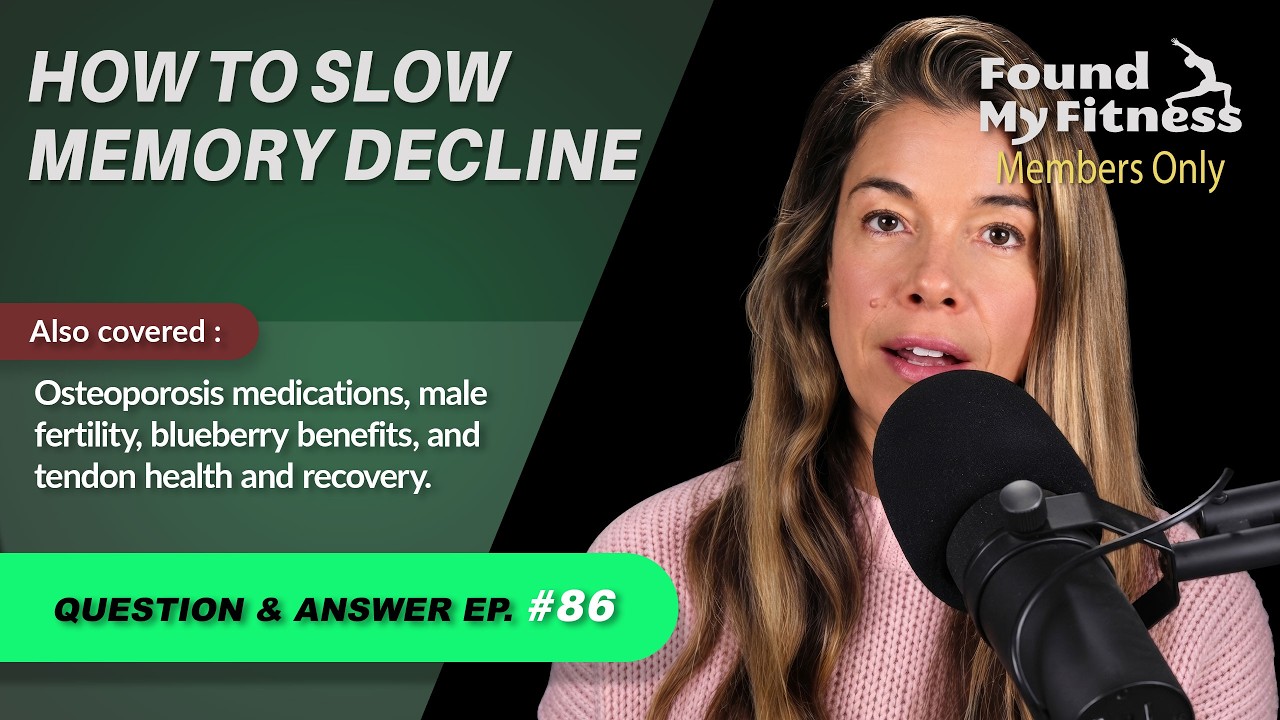
Q&A #86: How to Slow Memory Decline—Plus Tendon Recovery
Dr. Rhonda Patrick discusses memory, tendon and bone health, male fertility, and the benefits of blueberries.
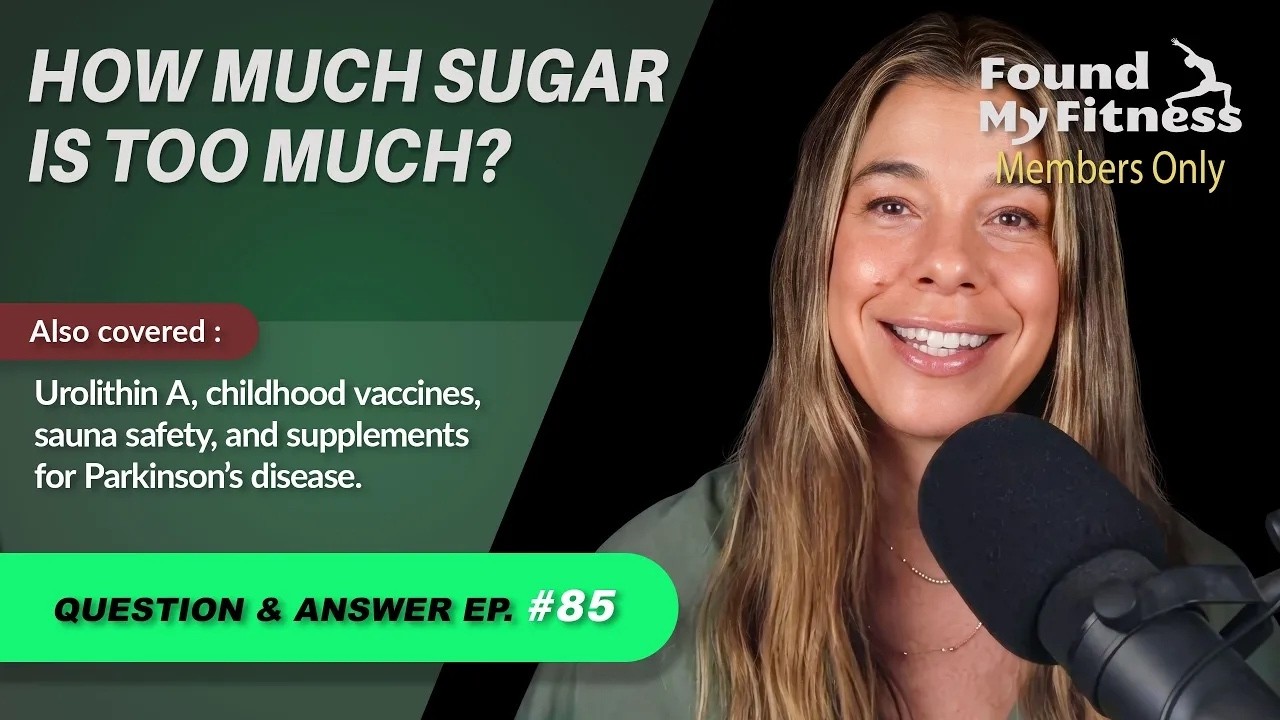
Q&A #85: How Much Sugar Is Too Much—and Can Supplements Help Parkinson's?
Dr. Rhonda Patrick discusses urolithin A, postmenopausal protein, microplastics, high-temperature saunas, sugar intake, and supplements for Parkinson's disease.
Q&A #84: Chemical Sunscreen Safety—Plus What Rhonda Eats
Dr. Rhonda Patrick discusses sunscreen safety, HIIT & brain health, diet, omega-3s, urolithin A, sulforaphane, homocysteine, peptides, and CoQ10.
Q&A #83: Does Glucosamine Worsen Alzheimer’s Disease?
Dr. Rhonda Patrick discusses glucosamine and Alzheimer's, blood flow restriction, beta-glucan fiber, creatine, collagen, red light therapy, and curcumin.
Q&A #82: Organic Food, Pesticides & Glyphosate—What Actually Lowers Exposure?
Dr. Rhonda Patrick discusses organic produce, fasting-mimicking diets, sleep, sauna, sunscreens, red light therapy, reverse osmosis water, and fiber.