Q&A
Q&A #74: How to Slow Immune Aging—Plus Gluten, Stroke Risk, & APOE4
Dr. Rhonda Patrick discusses stroke risk, eczema, immune resilience, her new smoothie recipe, and whether everyone should cut out gluten.

FoundMyFitness library
Ranked by shared topics, with one result from each original episode.
Q&A
Dr. Rhonda Patrick discusses stroke risk, eczema, immune resilience, her new smoothie recipe, and whether everyone should cut out gluten.
Q&A
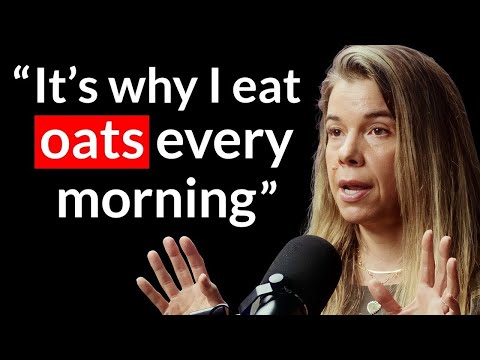
“The discussion of fiber and nutrient or supplement absorption begins at 19:38. The Oats and beta-glucan topic provides the wider cholesterol evidence and explains why whole oats, beta-glucan powder, and psyllium should not be compared solely by their serving weights.”
Clip
“In humans, an analysis of 6,482 US adults associated higher fiber intake with lower serum concentrations of several persistent PFAS chemicals; the observational result does not prove that fiber caused clearance. Sauna is a different pathway, not a substitute for fiber.”
Clip
“Listen as recent podcast guest from episode 72 of the FoundMyFitness podcast, Dr. Morgan Levine, describes the importance of this step in making her epigenetic clock PhenoAge and that of her postdoctoral mentor GrimAge more accurate in their ability to detect biological age and epigenetic age acceleration.”
Clip
“Dr. Panda discusses the effects of time-restricted feeding on systemic inflammation; time-restricted eating as an opportunity for night-time repair that may prevent intestinal hyperpermeability (i.e., leaky gut), a primary source of systemic inflammation; and how the timing of macronutrients may differentially affect gut permeability.”
Clip
“Red yeast rice lowers LDL through monacolin K, which is chemically identical to lovastatin, so it shares statin-related mechanisms and requires attention to potency, contamination, medicine interactions, and muscle or liver effects.”
Clip
“In a four-month randomized trial of 88 overweight, untrained middle-aged adults, daily doses of 500 or 1,000 milligrams improved some muscle and mitochondrial measures, while the primary outcome of peak power did not significantly improve.”