Sauna use and heat for strength preservation (anti-atrophy effect) | Rhonda Patrick
Get the full length version of this episode as a podcast.
This episode will make a great companion for a long drive.

The Omega-3 Supplementation Guide
A blueprint for choosing the right fish oil supplement — filled with specific recommendations, guidelines for interpreting testing data, and dosage protocols.
You'll also receive updates from Rhonda & FoundMyFitness
Sauna bathing after high-intensity exercise can reduce delayed onset muscle soreness (DOMS) and improve muscle strength. In addition, research demonstrates that local heat exposure prevents muscle atrophy in immobilized patients. Both of these effects may be due to the activation of heat shock proteins. In this clip, Dr. Rhonda Patrick discusses how heat can be used to increase muscle strength and counteract muscle wasting.
You know, there's also been some other studies. I usually do it after a workout. It's been like— there's been a study showing that it reduced delayed onset muscle soreness and improved muscle strength after high-intensity training. Yeah, I heard that. Doesn't it increase testosterone in men too or something like that or muscle growth hormone or something like that? Growth hormone. Growth hormone, yeah. And so, which can be potentially, you know, linked to muscle mass. But also, you know, there's been a— there was a recent study where it was local heat exposure and it was done in people that were— they immersed immobilize them for like 7 days. So, they expose them to the heat or not, and they found that being exposed to the heat prevented muscle atrophy by like 40%. Wow. So, it's huge.
And, this is like really in line with animal studies that I have talked about in the past. So, I was really happy to see that repeated in humans. And, I think that has largely to do with the heat shock proteins and growth hormone. So, the animal studies showed that it was dependent on heat shock proteins. So, heat shock proteins are one of the most protective adaptive responses to heat stress that are induced. And, it's not just heat stress. Things like cold also can induce heat shock proteins. Sulforaphane can induce heat shock proteins. Heat does it really robustly. Awesome.
But yeah, I think that— so, they've been shown to protect against muscle atrophy, against a variety of diseases that are as a consequence of aggregated proteins like cardiovascular atherosclerosis, Parkinson's, Alzheimer's. Animal studies have shown that they can prevent and also help reverse some of that. pathology. And the good news is that like there's been some human studies that have shown that people that go into the sauna about 163°F and stay in for 30 minutes can activate their heat shock proteins 50% above their baseline. And that, you know, so heat shock proteins can remain activated for about 48 hours. And the cool thing is, is that this happens quicker and better in people that are heat adapted. Oh, really? Yeah.
And heat shock proteins have been linked to longevity, to human longevity, also longevity— there's been longevity studies in lower organisms, you know, like flies. It's also great for sleep too, you know, doing it just before. Yeah, it's phenomenal. It totally helps me. It helps with my sleep. It's repeatable, hands down, for sure.
Get email updates with the latest curated healthspan research
Support our work
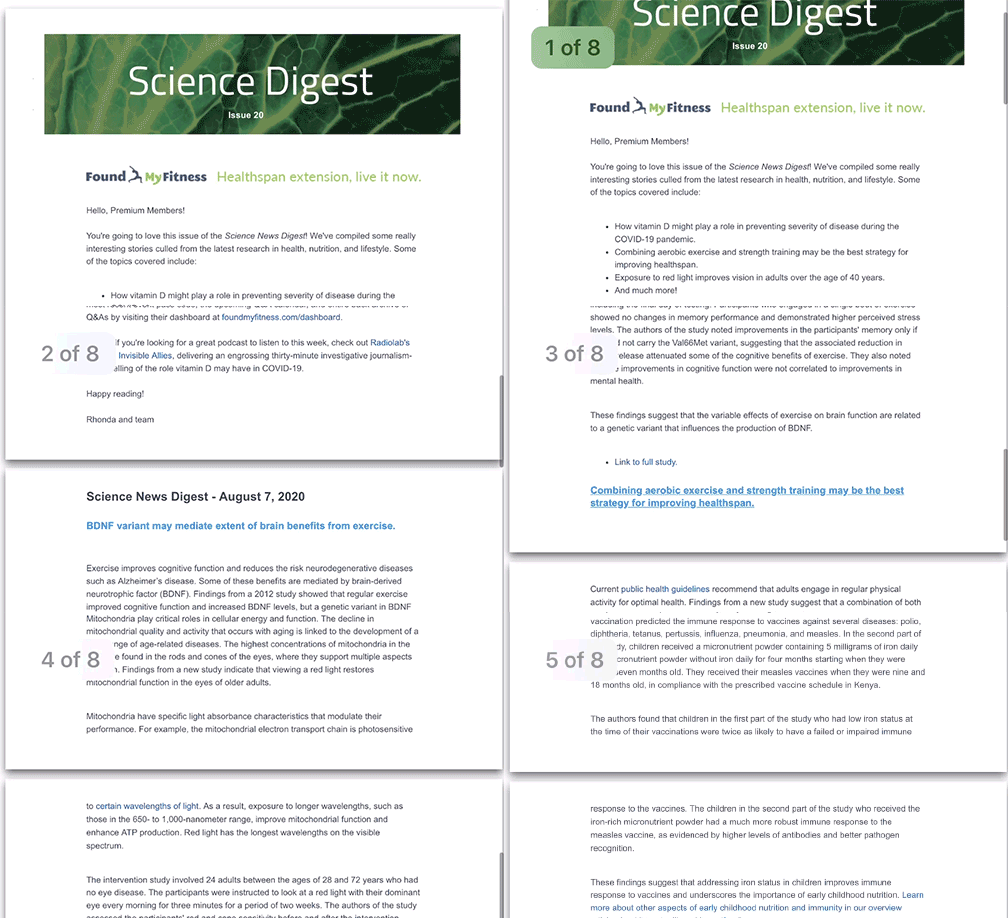
Every other week premium members receive a special edition newsletter that summarizes all of the latest healthspan research.